
A receipt is the smallest document in finance. It's also the one you need most when something goes wrong.
You need it to return a jacket, to claim a business lunch, to prove a purchase to the tax office or to get money back from your employer.
Most people never think about what a receipt actually is, what has to be on it, or how long it lasts. This guide answers all of that, with real receipts from six countries.
Receipt Definition
A receipt is a written record that confirms money, goods or services have been received.
In practice, it's the slip, email or PDF a seller gives you after you pay. It shows who sold what, to whom, when, and for how much.
The dictionaries agree:
- Merriam-Webster: "a writing acknowledging the receiving of goods or money." (Merriam-Webster)
- Cambridge: "a piece of paper that shows the price of something that you have bought and proves that you have paid for it." (Cambridge Dictionary)
The word has two other meanings you'll run into:
- The act of receiving. "Payment is due within 30 days of receipt" means 30 days after the invoice arrives.
- Receipts (plural) as income. In accounting, "gross receipts" is the total money a business takes in. The IRS uses it that way: cash register tapes, deposit slips and receipt books are all records of gross receipts. (IRS)
How Do You Spell Receipt?
It's spelled R-E-C-E-I-P-T, and it's pronounced ri-SEET. The P is silent. (Merriam-Webster)
Two things trip people up:
- The E-I order. Receipt follows the old rule "I before E, except after C": it's c-ei, not c-ie.
- The silent P. It's there for historical reasons, not because anyone ever said it.
Common misspellings include reciept, receit, recipt, reciet and recept.
Why Receipt Has a Silent P
English borrowed the word in the 14th century from Anglo-French receite, with no P. (Etymonline)
Around 1500, writers started putting the P back to match the Latin root recepta, "things received." The pronunciation never changed. (Etymonline)
The same thing was tried with conceit and deceit, which come from the same Latin root. The P only stuck in receipt. (Etymonline)
One more surprise: receipt used to mean recipe. Old cookbooks talk about "a receipt for pound cake." Both words come from Latin recipere, "to receive." (Merriam-Webster)
Receipt in Other Languages
| Language | Word for receipt |
|---|---|
| German | Kassenbon, Quittung, Beleg |
| Dutch | Kassabon, bonnetje, kwitantie |
| French | Reçu, ticket de caisse |
| Spanish | Recibo |
| Thai | ใบเสร็จรับเงิน (bai set rap ngoen) |
| Filipino | Resibo |
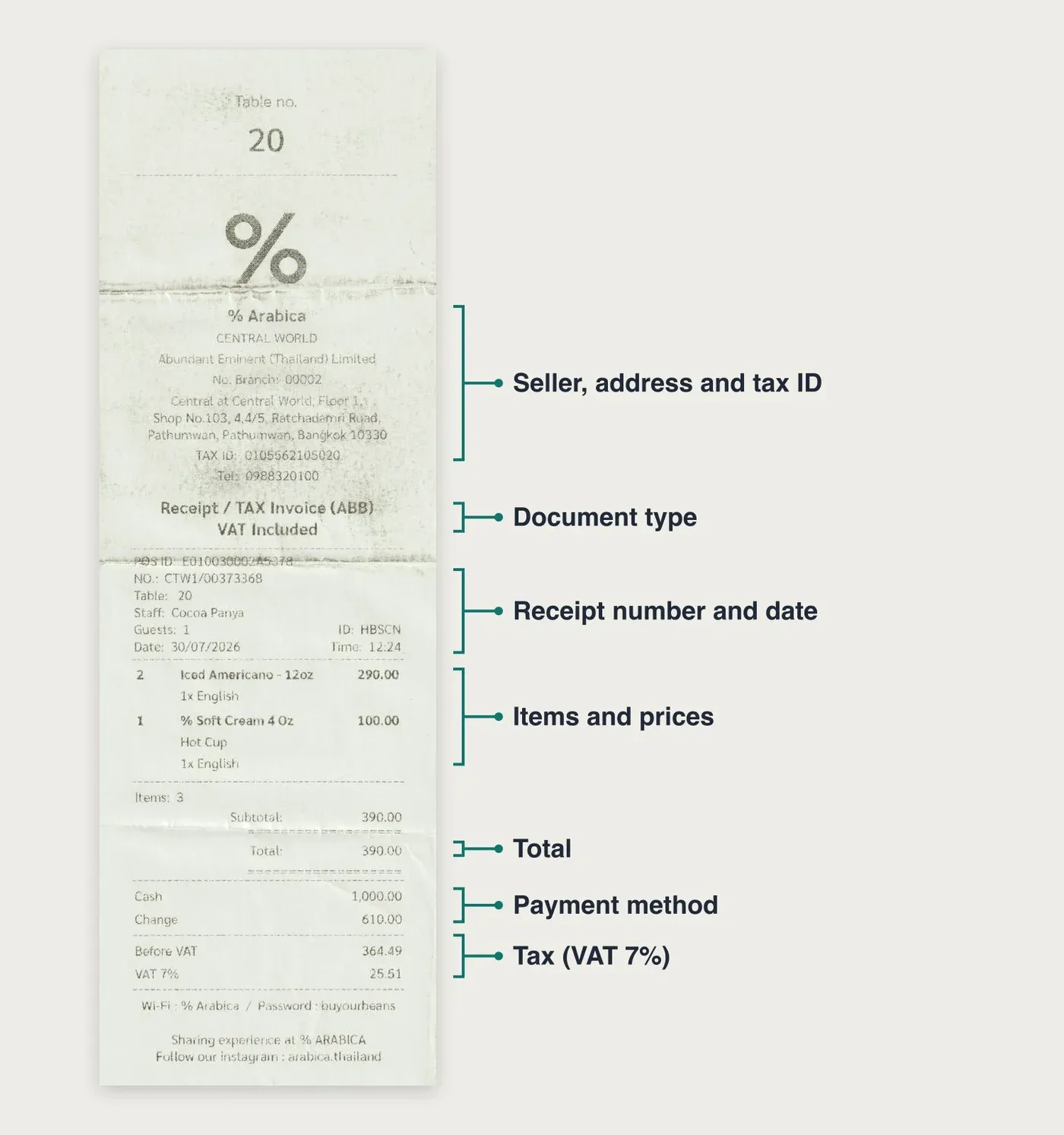
What Is on a Receipt?
Every country has its own rules, but almost every receipt shows the same core details:
- Seller: business name and usually an address.
- Date and often the time of the sale.
- What was bought: items or services, with quantities and prices.
- Total paid.
- Tax: sales tax in the US, GST/HST in Canada, VAT in most other countries.
- Payment method: cash, card (with only the last digits shown), mobile wallet.
- A reference number: transaction, check or receipt number.
Many receipts add a tax registration number for the seller, a cashier name, a return policy and a loyalty or survey message.
For tax purposes, the IRS calls a receipt adequate if it shows four things: the amount, date, place and essential character of the expense. (IRS Publication 463) We cover the IRS rules in detail in IRS Receipt Requirements.
Receipt Examples From Around the World
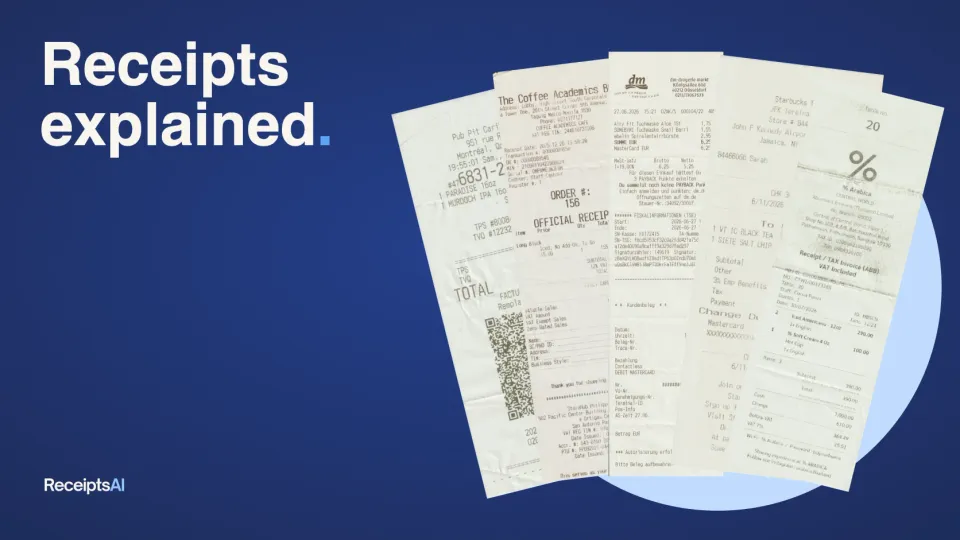
A receipt does the same job everywhere. What's printed on it depends on the country's tax rules. Here are real receipts from six countries, and what makes each one different.
United States
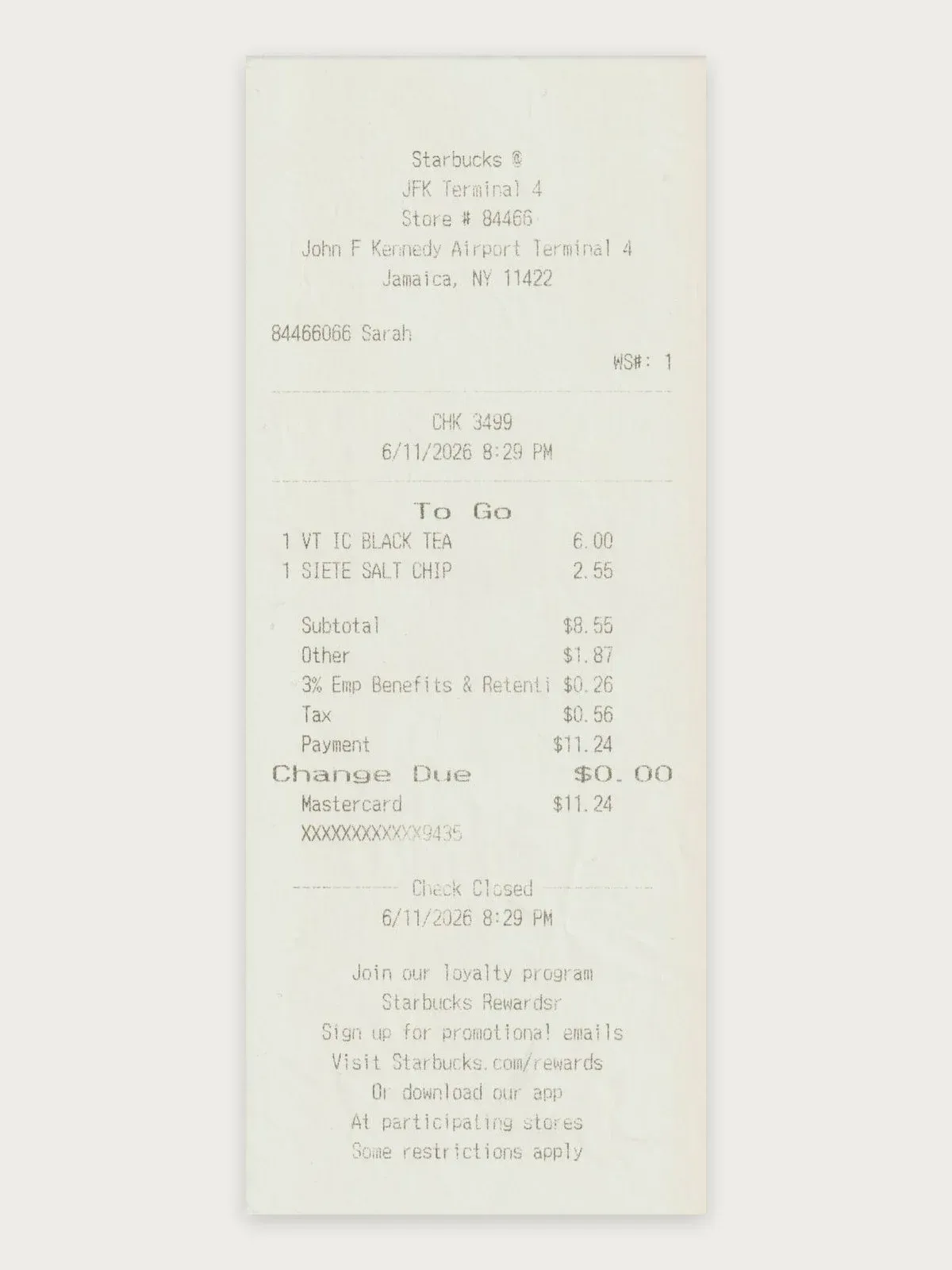
US receipts list prices before tax and add sales tax at the bottom. The rate depends on the state, county and city, so the same coffee can carry a different tax line a few miles away.
Watch for extra lines between the subtotal and the tax. This airport Starbucks adds an "Other" charge and a 3% employee benefits surcharge before the tax line, so the $8.55 order came to $11.24.
Card receipts can't show your full card number. Federal law allows no more than the last five digits, and the expiration date can't be printed at all. (15 U.S.C. § 1681c(g))
Canada
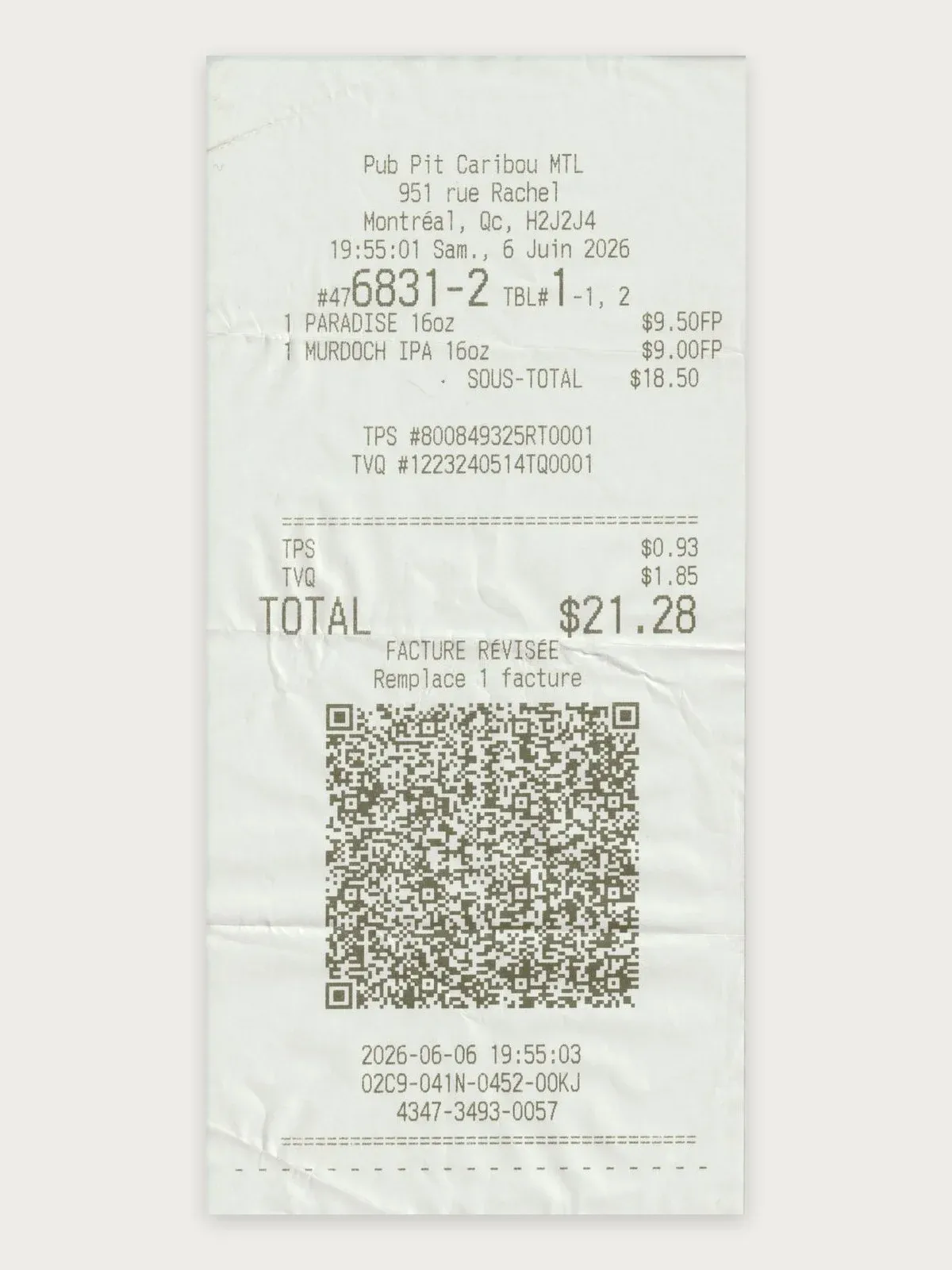
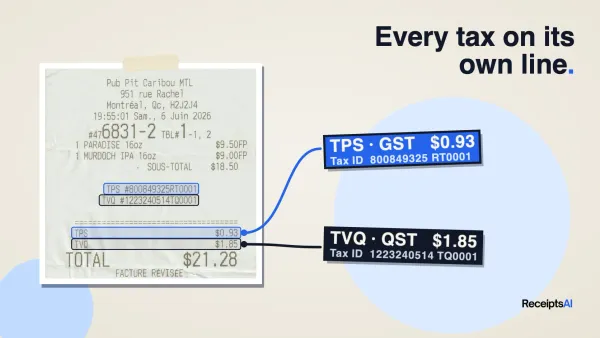
Canadian receipts show GST (federal), HST (harmonized, in some provinces) or GST plus PST/QST (provincial), each on its own line.
Quebec receipts are usually in French, so GST appears as TPS and QST as TVQ, each with the seller's registration number. Look for the codes RT0001 (GST) and TQ0001 (QST) at the end.
Quebec restaurant bills also carry a QR code. Since June 2025, every restaurant and bar must give each customer a bill produced by a certified sales system that reports the sale to Revenu Québec. Scanning the code shows a summary of the transaction. (Revenu Québec; Revenu Québec) That's why this one says Facture révisée, remplace 1 facture: a revised bill that replaces an earlier one, and both are on record.
For a business to claim back the GST/HST it paid, the receipt needs more detail as the amount goes up. Under $100, the seller's name, the date and the total are enough. From $100, the receipt also needs the seller's GST/HST registration number and the tax amount. From $500, it also needs the buyer's name, a description of what was bought and the payment terms. (Canada Revenue Agency)
Thailand
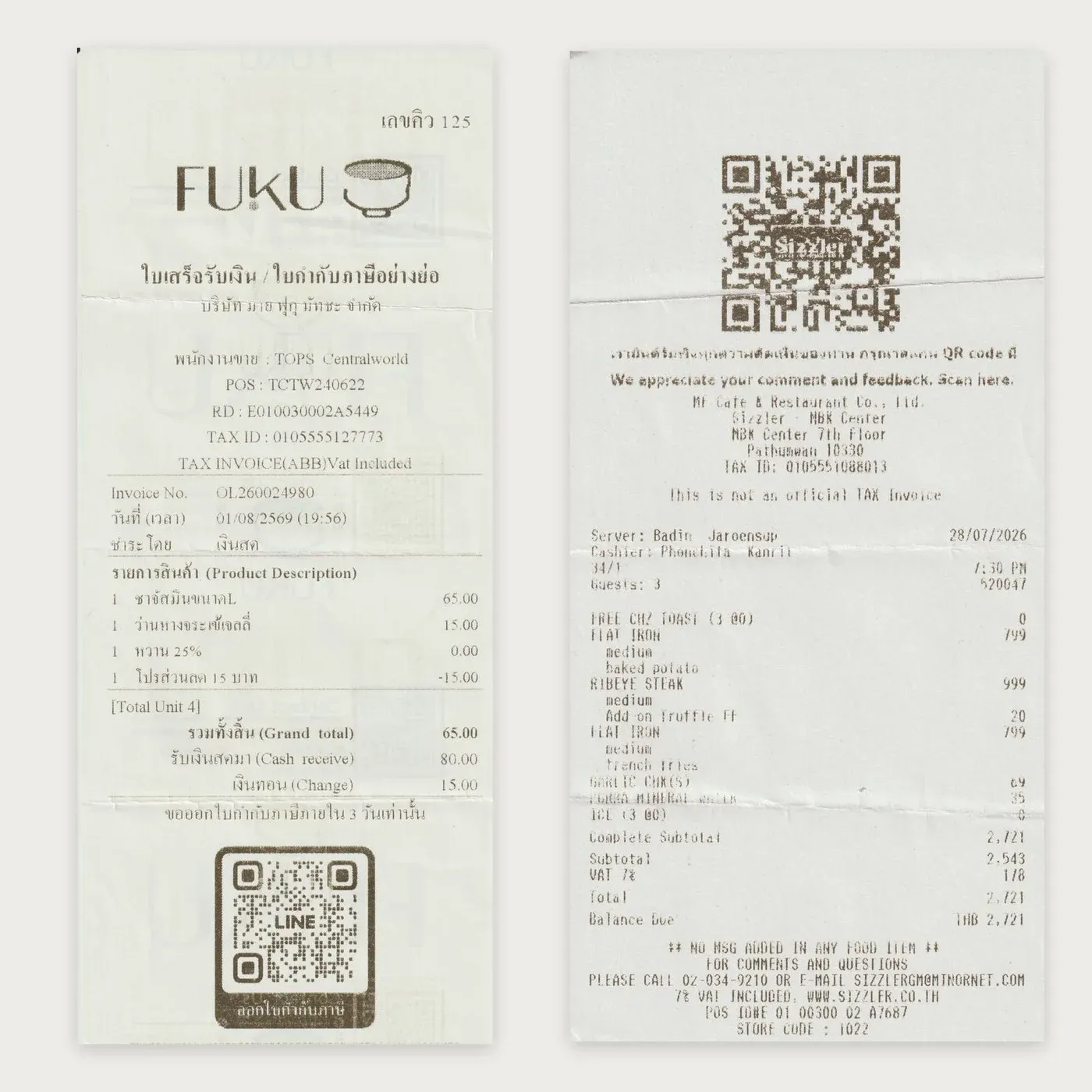
Most Thai shop receipts are an abbreviated tax invoice, marked TAX INVOICE (ABB) or ใบกำกับภาษีอย่างย่อ. They show the seller's tax ID and a price that already includes VAT, currently 7%. (Revenue Department, 2026) The FUKU receipt's header reads "receipt / abbreviated tax invoice" (ใบเสร็จรับเงิน / ใบกำกับภาษีอย่างย่อ).
Check the date, too. The FUKU receipt says 01/08/2569. That's the Thai Buddhist calendar, which runs 543 years ahead: 2569 is 2026.
Not every Thai receipt is a tax invoice. The Sizzler bill on the right shows a 7% VAT line but says "This is not an official TAX Invoice."
If you need to claim the VAT back, ask for a full tax invoice with your name, address and tax ID. VAT-registered retailers must issue one if the buyer asks. (Revenue Department, Section 90/2) Ask quickly: the FUKU receipt says it will only issue one within 3 days (and has a LINE QR code to request it), and a Dean & Deluca receipt from the same week says only on the day of purchase.
Germany
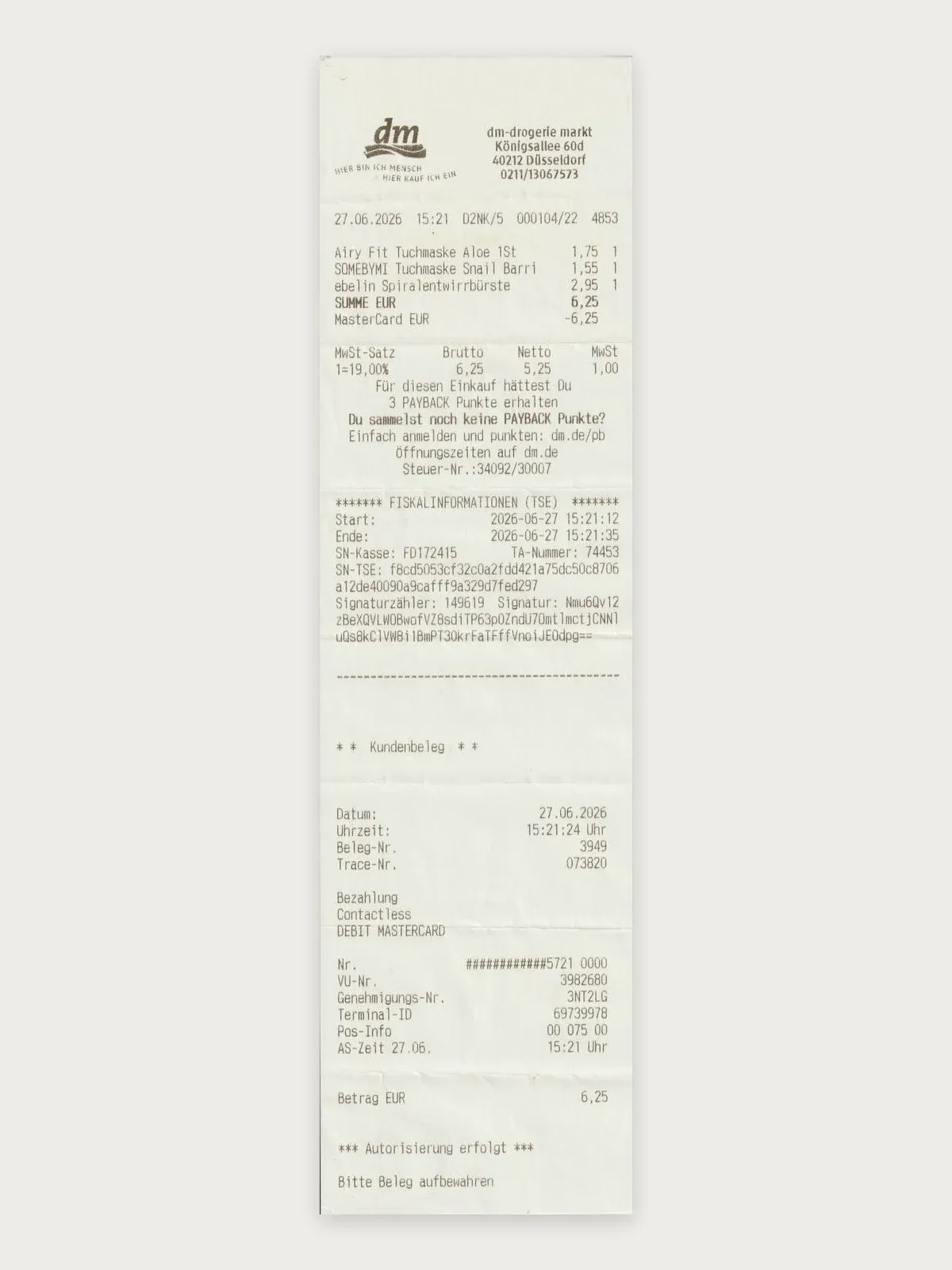
German receipts are long, and there's a reason. Since 2020, every till receipt must carry data from a certified security device, called a TSE, that stops tills from being tampered with. (German Federal Ministry of Finance)
So besides the seller, date, items, total and VAT rate (MwSt), a German Kassenbon shows a transaction number, the serial numbers of the till and the TSE, start and end times, a signature counter and a signature. The law lets the till print these as text or as a QR code. (§ 6 KassenSichV)
On the dm receipt, that's the block headed FISKALINFORMATIONEN (TSE). Below it is the card terminal's own slip, the Kundenbeleg (customer copy), which ends with Bitte Beleg aufbewahren: please keep your receipt.
Netherlands
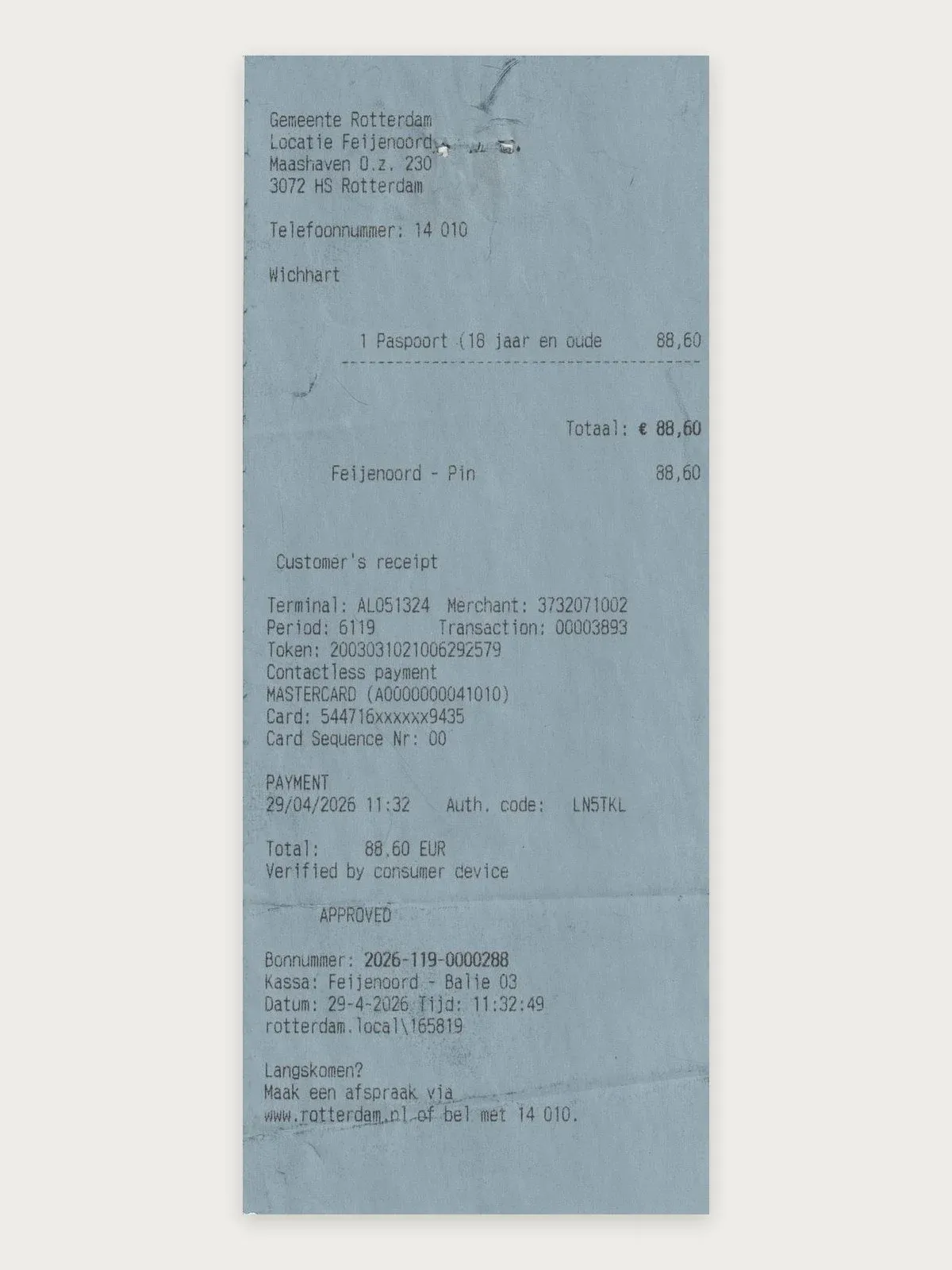
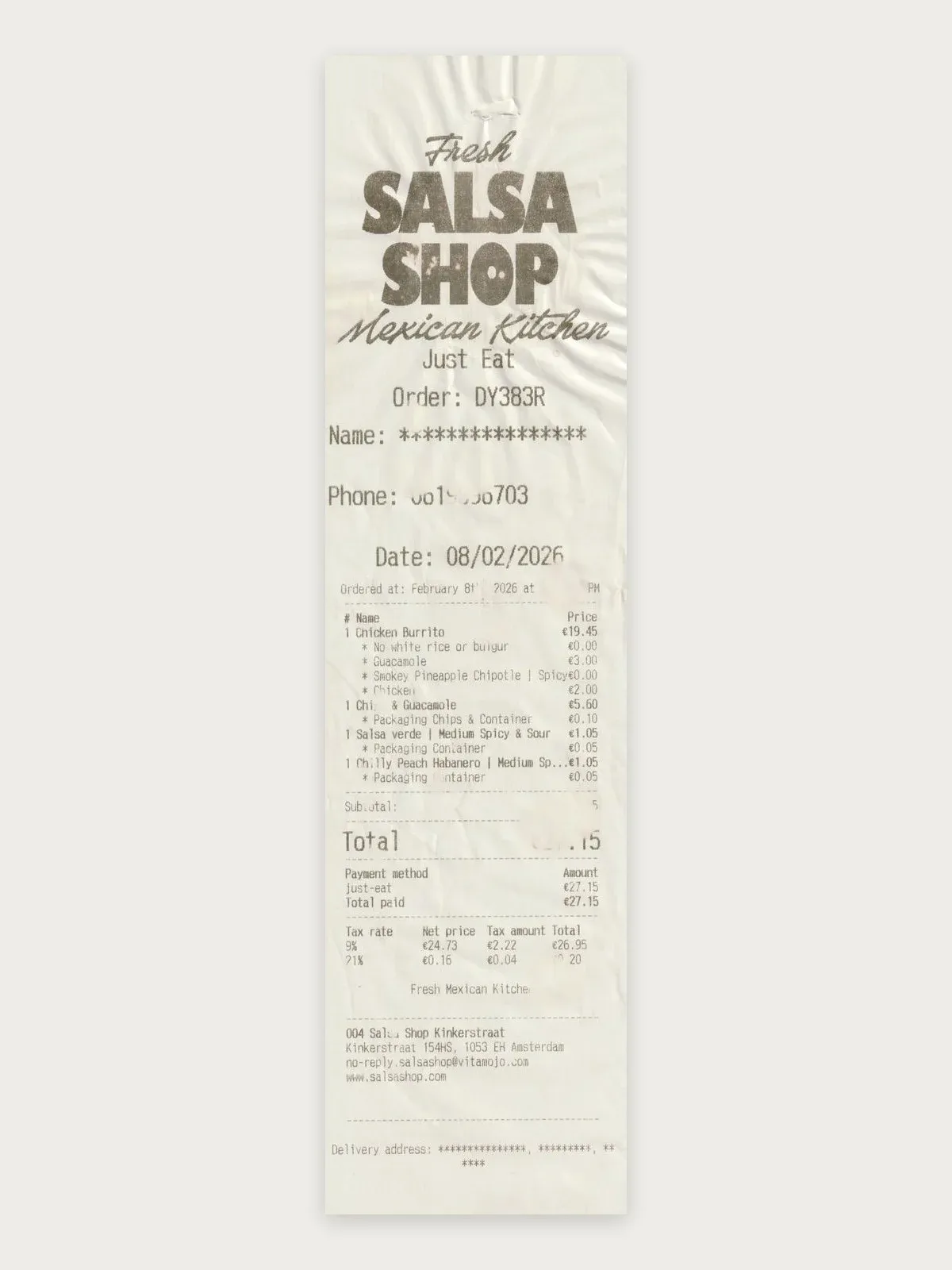
A Dutch kassabon or bonnetje usually lists the VAT (BTW) split by rate: 9% and 21%, side by side at the bottom. You can see that split on the Salsa Shop receipt further down.
This one from the city of Rotterdam has no BTW line at all, because a passport fee is a government charge, not a sale.
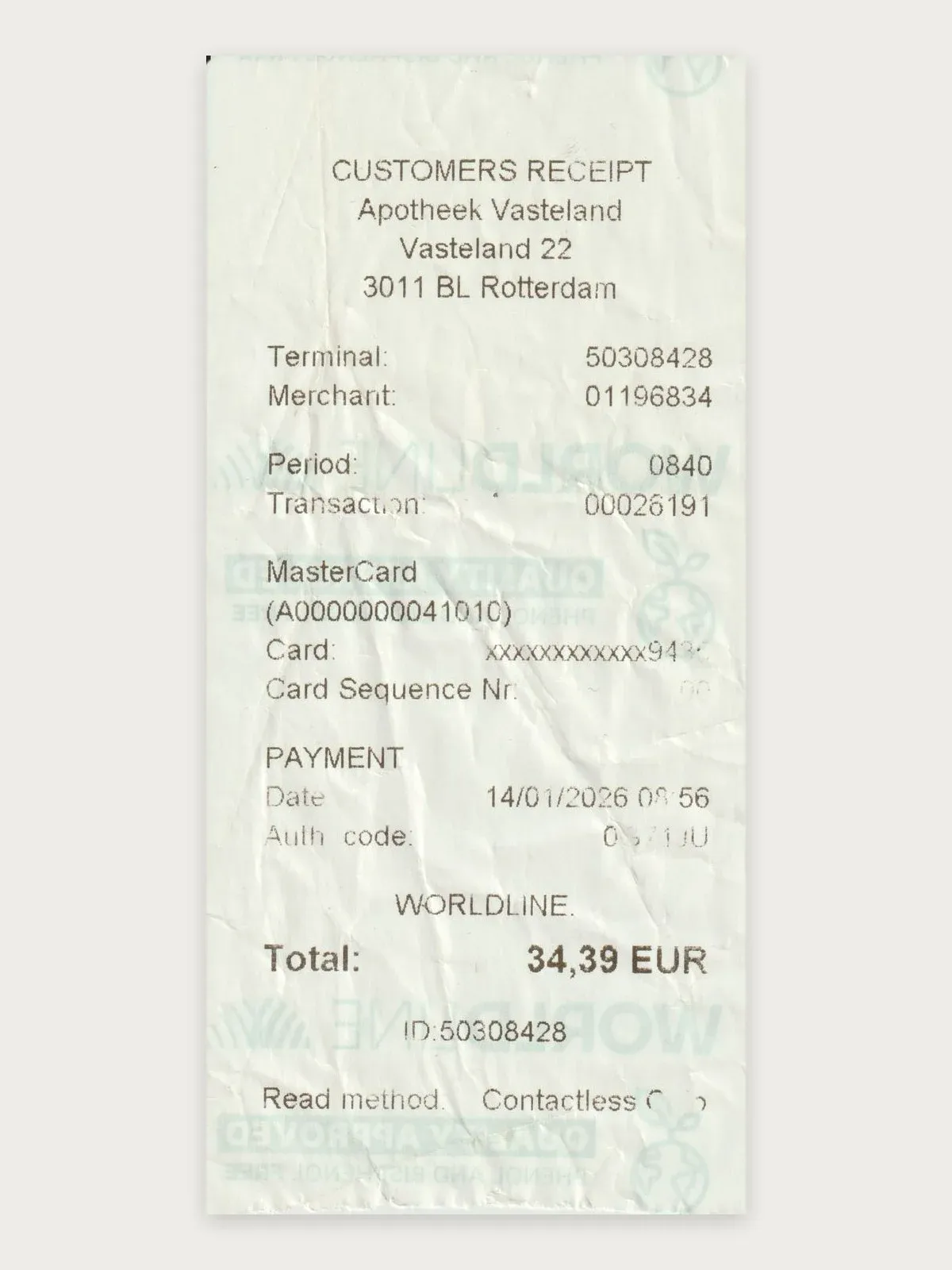
What it does show is typical of Dutch card payments: the payment terminal's slip, the Customer's receipt, printed right under the till receipt. It has the terminal and merchant IDs, a masked card number, the authorization code and "Contactless payment." The till part ends with a Bonnummer, the receipt number.
Philippines
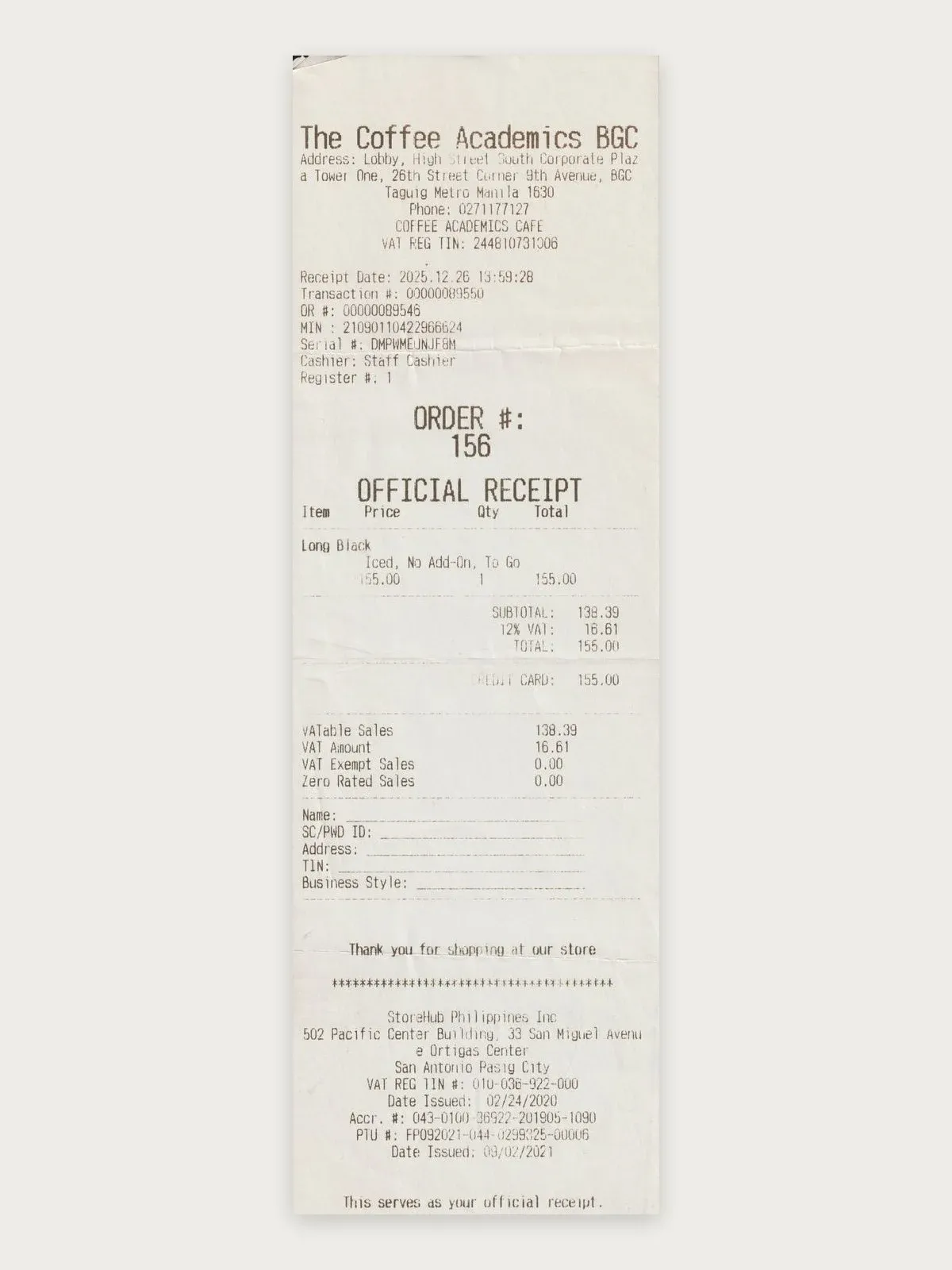
Philippine receipts are packed with registration data:
- The seller's VAT REG TIN (tax ID).
- The till's MIN (machine identification number) and serial number.
- A VAT breakdown: VATable sales, VAT amount (12%), VAT-exempt sales and zero-rated sales.
- Blank fields for the buyer's name, address and TIN, filled in when a business buyer needs the receipt for its books, plus an SC/PWD ID line for senior citizen and disability discounts.
- At the bottom, the details of the company that supplies the till software, with its accreditation and PTU (permit to use) numbers.
This one still says "Official Receipt." That label is on its way out. Under the 2024 Ease of Paying Taxes Act, the invoice is now the primary proof of a sale, for both goods and services, and an official receipt is only a supplementary document. (BIR, RMC 77-2024) Updated tills print "This serves as your Sales Invoice" instead.
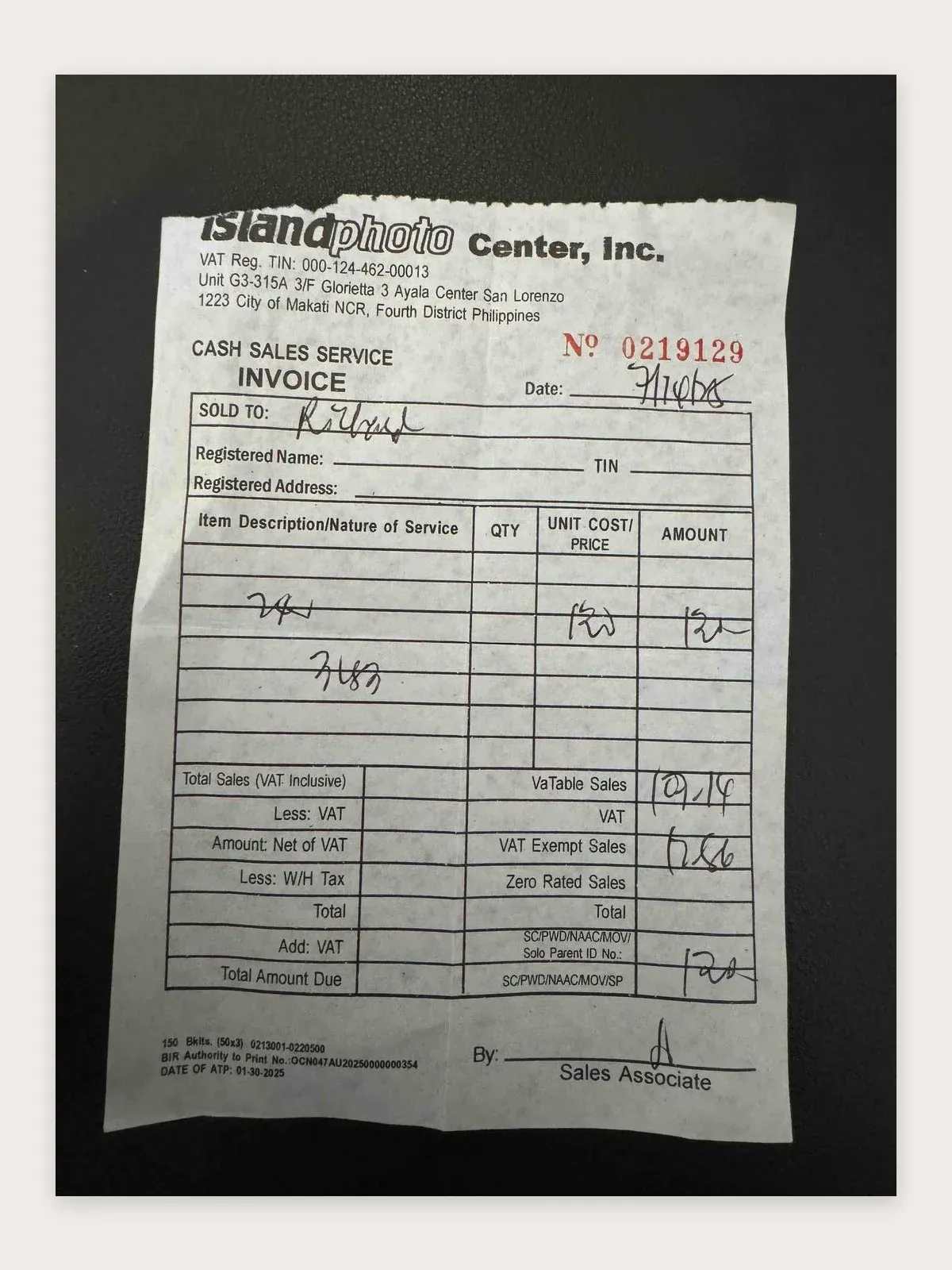
Handwritten receipts are still common at smaller shops. They're printed in booklets by a printer accredited by the Bureau of Internal Revenue (BIR), with the BIR's Authority to Print number at the bottom. There's one under Types of Receipts below.
Types of Receipts
"Receipt" covers a lot of different documents. Here are the ones you'll come across most.
Cash Register Receipt
The classic till receipt, printed on a narrow roll of thermal paper at the checkout. It's the most common receipt in the world, and the one most likely to fade. The IRS calls these "cash register tape receipts." (IRS)
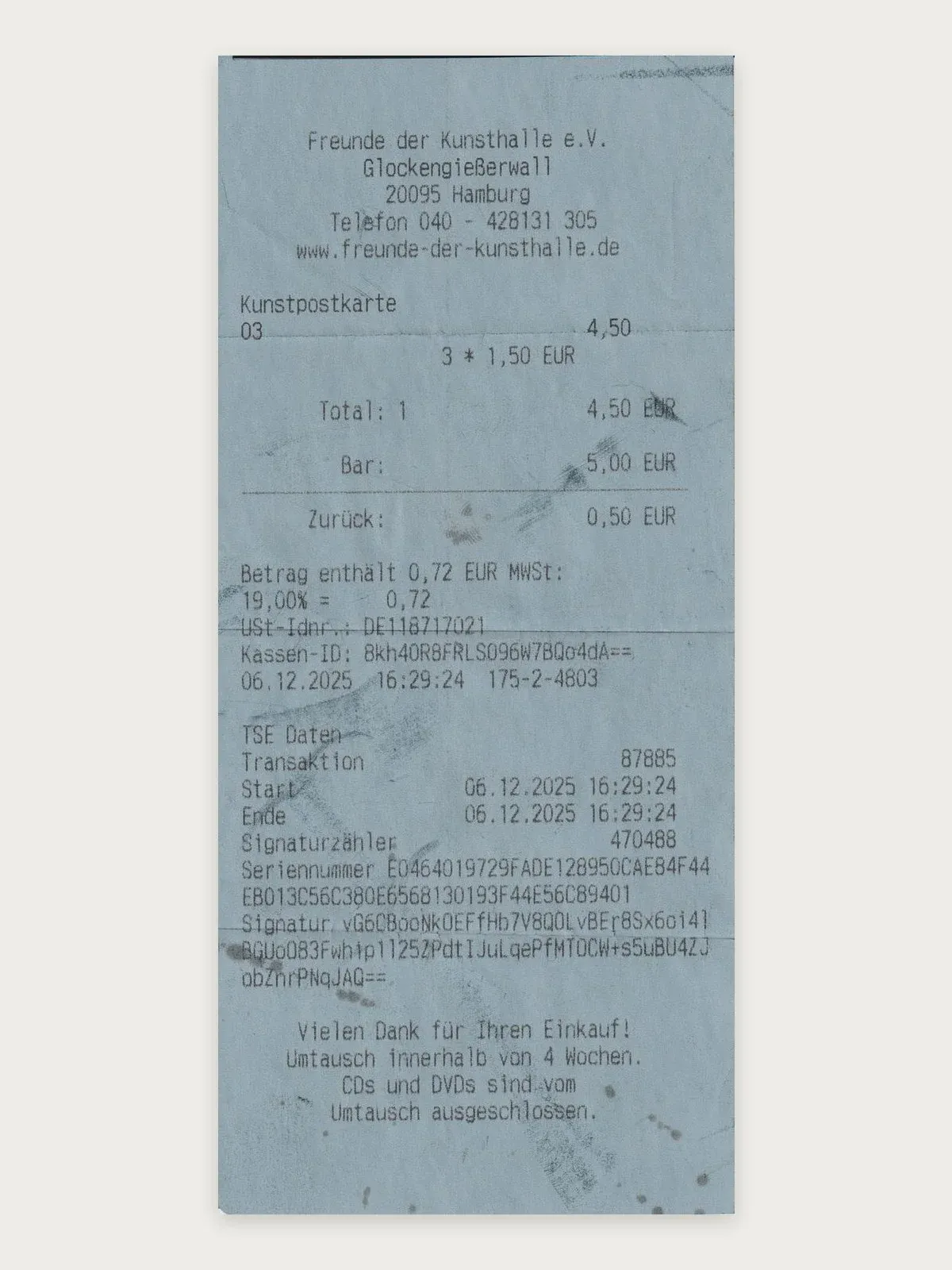
Credit and Debit Card Receipt
The slip from the card terminal. It shows the merchant, amount, date, a masked card number and an authorization code.
On its own, it usually doesn't show what you bought. That matters for tax. The IRS says a restaurant receipt proves a business meal only if it shows the restaurant's name and location, the number of people served, and the date and amount. (IRS Publication 463) Keep the itemized receipt, not just the card slip.
Itemized Receipt
A receipt that lists every item or service with its price, rather than just a total. Most expense policies and tax offices want itemized receipts.
Handwritten Receipt
Written by hand, often from a pre-printed receipt book. Common for small shops, market stalls, tradespeople, rent and cash sales. A handwritten receipt is just as valid as a printed one if it has the required details.
Digital Receipt (E-Receipt)
A receipt sent by email, text or app instead of on paper. More shops offer them every year. Germany's receipt law allows them by email or phone, and France stopped printing till receipts automatically in 2023. (German Federal Ministry of Finance; French Ministry of Economy) More on that in Digital vs Paper Receipts.
Order Confirmation
The email you get after buying online. It often looks like a receipt, but it isn't always one.
An order confirmation says the shop accepted your order. It doesn't always prove you paid, or that the goods shipped. Many online shops send a separate payment receipt, shipping confirmation or invoice later. For an expense claim or a tax deduction, keep the document that shows payment.
The best online order receipts do both. The one below came with a Just Eat delivery: it has the order number, every item, "Total paid" and the VAT split by rate.
Invoice Marked Paid
An invoice with "Paid" or a payment date on it. Freelancers and B2B suppliers often send this instead of a separate receipt.
Other Receipts You'll See
- Hotel folio: the itemized bill at checkout. The IRS wants it to show the hotel name and location, your dates, and separate amounts for lodging, meals and phone calls. (IRS Publication 463)
- E-ticket receipt: for flights and trains.
- Donation receipt: from a charity. In the US, you need a written acknowledgment for any gift of $250 or more. (IRS)
- Rent receipt: from a landlord, often handwritten.
- Gift receipt: a receipt with the prices hidden, so the recipient can return or exchange the item.
- Refund or return receipt: proof that money went back to you.
- ATM receipt: a record of a cash withdrawal or deposit.
- Delivery receipt: proof that goods arrived, signed by whoever received them.
Receipt vs Invoice
An invoice asks for payment. A receipt confirms payment.
The invoice comes first: "here's what you owe, please pay by this date." The receipt comes after: "we got your money."
| Invoice | Receipt | |
|---|---|---|
| Purpose | Requests payment | Confirms payment |
| When it's issued | Before payment | After payment |
| Typical use | Business to business, freelancers, utilities | Shops, restaurants, consumers |
| Shows a due date | Yes | No |
| Shows payment method | Sometimes | Usually |
| Main proof for VAT recovery | Usually yes | Sometimes (depends on country) |
In real life the line blurs:
- At a shop, the till receipt is often the only document, and it doubles as a simplified invoice.
- An invoice marked "Paid" works as a receipt.
- In the Philippines, the law flipped the usual order in 2024. The invoice is now the primary proof of a sale for both goods and services, and an official receipt is only a supplementary document. (BIR, RMC 77-2024)
- In Thailand, the document that counts for VAT is the tax invoice. A shop receipt is usually an abbreviated version of one. (Revenue Department)
Receipt FAQs
How long does a receipt last?
A printed thermal receipt should stay readable for at least 5 to 7 years, but only if it's stored in the dark, below 25°C (77°F), at moderate humidity, and away from plastics and oils.
Appvion, one of the largest thermal paper makers, expects its standard paper to stay legible for at least seven years under those conditions. (Appvion, 2023) Koehler guarantees 5 to 12 years, depending on the paper grade. (Koehler)
In a wallet, a car or a coat pocket, a receipt can go unreadable in months.
Receipts printed with ink on regular paper last much longer, and a digital receipt lasts as long as you keep the file.
Do receipts fade over time?
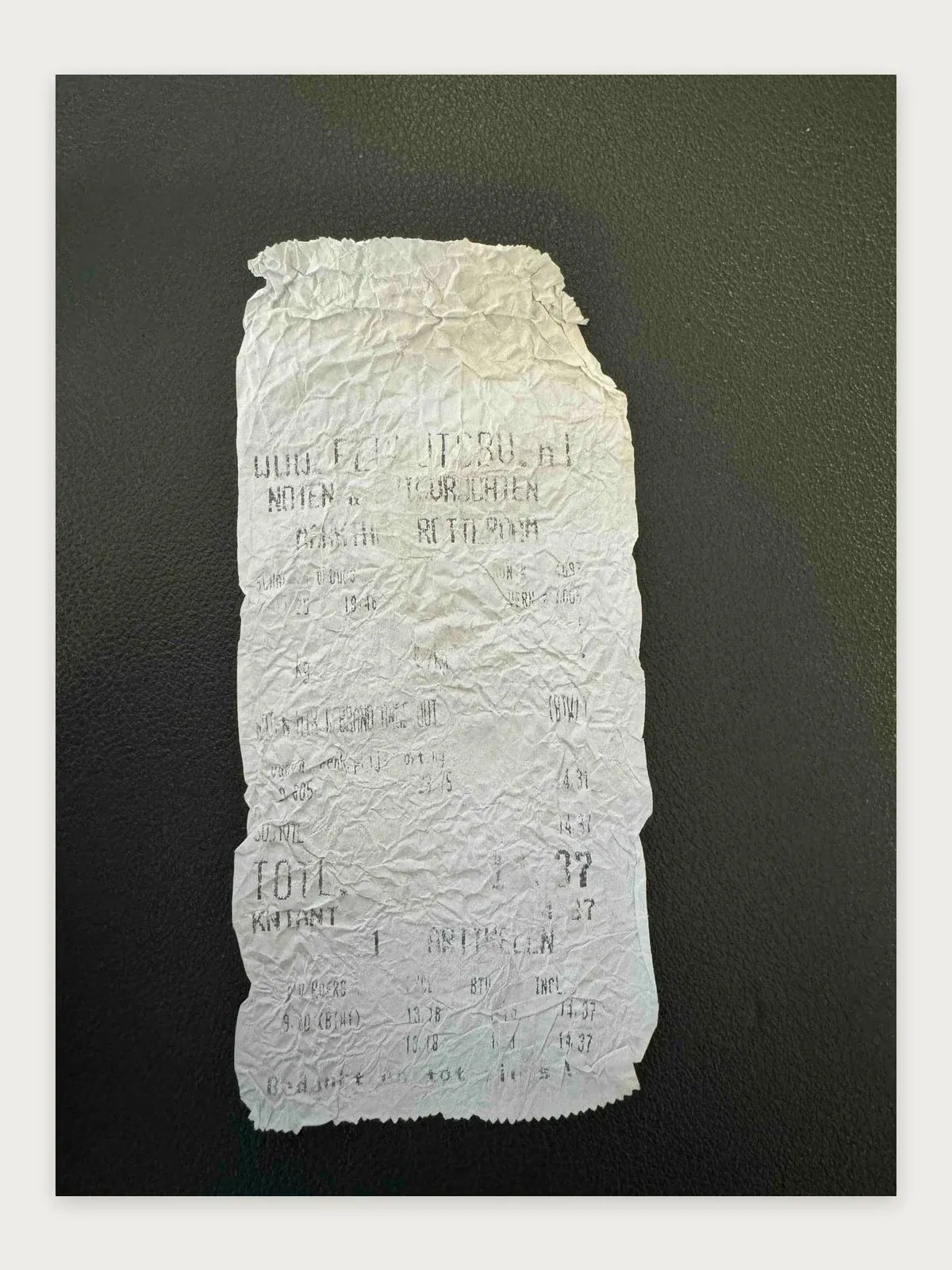
Yes, thermal receipts do. There's no ink. The text is a heat-sensitive coating that darkens where the printer head heats it, and the same chemistry slowly reverses.
Thermal paper makers list what speeds up fading (Appvion, 2023; Koehler):
- Heat: a hot car or a sunny dashboard.
- Light: especially sunlight.
- Humidity and water.
- Plastic: soft PVC sleeves and wallets contain plasticizers that wipe the print.
- Hand cream, oils, sanitizer, solvents and glue.
- Folding and crumpling: the coating cracks along creases.
Australia's tax office lists "faded receipts or no digital backups" among the record-keeping mistakes it sees in small businesses. (ATO, 2025)
The fix is simple: photograph or scan a receipt the day you get it. Most tax offices accept a good scan. See How to Scan Receipts Into Excel.
Are receipts toxic?
Thermal receipts can contain bisphenols, chemicals used as the developer in the heat-sensitive coating. For years that was BPA. Since the EU limited BPA in thermal paper to 0.02% by weight from January 2020, most makers have switched to BPS. (European Commission, 2016; ECHA, 2020)
A 2023 test of 245 US receipts found 80% coated with BPS and 2% with BPA. (Ecology Center, 2023)
The chemicals can pass through skin. Cashiers in France had BPA levels about 2.5 times higher than people who don't handle receipts at work. (Ndaw et al., 2016) Hand sanitizer makes it worse: holding a receipt with sanitizer-wet hands, then eating, caused a quick spike in blood BPA in a small study. (Hormann et al., PLOS ONE, 2014)
Touching a receipt now and then isn't something to panic about. Handling them all day is a different story. If you want to cut your exposure:
- Take a digital receipt when it's offered.
- Don't hold receipts with wet or sanitized hands.
- Wash your hands before eating after handling a lot of receipts.
- Keep receipts away from children's mouths.
For more numbers, see the BPA section of our receipt statistics.
Does it matter if my receipt is on thermal paper or regular A4 paper?
Legally, no. Tax offices care about what's on the receipt, not what it's printed on. A receipt is valid if it has the required details: seller, date, items, amount and tax.
Practically, yes. A thermal receipt fades, an A4 receipt printed with ink doesn't. If you're keeping a thermal receipt for years, scan it.
A few related questions come up a lot:
- Is a photo or scan as good as the original? Usually, yes. The IRS accepts scanned receipts from a system that meets its rules (IRS Publication 583). The Dutch tax office lets you throw away the original once you have a complete, accurate scan. (Belastingdienst)
- Is an email receipt as good as a paper one? Yes. Keep it in the form you got it. The Dutch tax office says digital invoices should be saved digitally, not printed. (Belastingdienst) Canada's tax agency says electronic records must be kept in electronic form. (Canada Revenue Agency)
What happens if I'm not given a receipt?
First, ask for one. Most businesses will print or email one on the spot, or reprint it later from their system.
Whether a business has to give you a receipt depends on the country:
- Germany: any business with an electronic till must issue a receipt for every sale, on paper or electronically. You don't have to take it. (German Federal Ministry of Finance)
- Philippines: VAT-registered sellers must issue an invoice for every sale, whatever the amount. Non-VAT sellers must issue one above ₱500, or whenever the buyer asks. (BIR, RMC 77-2024 digest)
- Thailand: VAT-registered businesses must issue a tax invoice, and must issue a full one if the buyer asks. Failing to do so can mean a fine of up to 5,000 baht, a month in prison, or both. (Revenue Department, Section 90/2)
- Netherlands: businesses don't have to give consumers an invoice, with a few exceptions. Business customers are entitled to one. (Belastingdienst)
- France: till receipts are printed only if you ask, since August 2023. (French Ministry of Economy)
If you need to prove a business expense and you don't have a receipt, other documents can fill the gap. The IRS lists canceled checks, account statements, and credit card receipts and statements, and notes that "a combination of supporting documents may be needed." (IRS)
A bank or card statement alone proves you paid, not what you paid for. A canceled check "by itself doesn't prove a business expense without other evidence to show that it was for a business purpose." (IRS Publication 463) Write down what you bought and why, on the day.
What should I do if I lose a receipt?
- Ask the seller for a copy. Many tills and online shops can reprint or resend a receipt.
- Check your email and apps. Online orders, ride apps and many shops send one automatically.
- Pull the line from your bank or card statement to prove the payment.
- Write a short note: date, seller, amount, what it was for and who was there.
- For travel, gift and car expenses in the US, you don't need a receipt for expenses under $75, except for lodging. (IRS Publication 463)
Some employers have a "missing receipt" form for exactly this. Don't recreate a receipt yourself. A made-up receipt is a fake receipt, even if the expense was real.
How long should I keep my receipts?
It depends on the country, and on whether the receipt is for business or personal use.
| Country | How long to keep business records |
|---|---|
| United States | 3 years in most cases; 6 if you underreport income by more than 25%; 7 for bad debts or worthless securities (IRS) |
| Canada | 6 years from the end of the tax year they relate to (Canada Revenue Agency) |
| Germany | 8 years for receipts and invoices; 10 for books and annual accounts (§ 147 AO) |
| Netherlands | 7 years; 10 for real estate (Belastingdienst) |
| Thailand | At least 5 years; the Revenue Department can require up to 7 (Revenue Department, Section 87/3) |
| Philippines | 5 years, down from 10 before 2024 (RA 11976, Section 33) |
For personal receipts, keep them as long as you might need them: through the return or warranty period for purchases, as long as you own anything valuable you might need to insure, and for as long as you'd keep business records if you claimed the purchase on your taxes.
More countries, and the exceptions, are in our receipt statistics.
Can I throw away the paper receipt after scanning it?
In many countries, yes, as long as the scan is complete and readable.
- United States: yes, if your scanning system meets IRS Rev. Proc. 97-22. (IRS Publication 583)
- Netherlands: yes, if the scan is a complete and accurate copy of the original. (Belastingdienst)
- Philippines: records you keep on paper must be preserved in hard copy; computerized records in electronic form. (BIR, RR 7-2024)
When in doubt, check with your accountant before you shred.
Is a bank statement a receipt?
No. A bank or card statement proves money left your account. It doesn't show what you bought, so it doesn't replace a receipt on its own. The IRS says "a combination of supporting documents may be needed" to prove an expense. (IRS)
Do I need a receipt for small purchases?
For your own shopping, only if you might return the item.
For business expenses, the rules vary. In the US, you don't need receipts for travel, gift and car expenses under $75 (lodging excepted), but you still need to record them. (IRS Publication 463) In Canada, a GST/HST claim under $100 only needs the seller's name, the date and the total. (Canada Revenue Agency)
Can I get a copy of a receipt?
Usually. Most modern tills store every transaction, so the shop can reprint it if you bring the date, time and payment card. Online shops let you download receipts from your order history. Reprints are often marked "duplicate" or "reprint," so whoever reviews it knows it isn't a second purchase.
What is a receipt in accounting?
In accounting, "receipts" usually means money coming in: cash receipts, gross receipts, tax receipts. A receipt document is the source document that backs up an entry in the books. Every expense in your ledger should trace back to one. That's why receipts are the first thing an auditor asks for.
Keeping Receipts Without the Shoebox
Receipts fade, get lost and pile up. The easiest way to keep them is to stop keeping paper:
- Capture the receipt the day you get it. Snap a photo or forward the email.
- Store it somewhere searchable, not a shoebox or an inbox folder.
- Pull the key details out: seller, date, amount, tax and category.
That's what ReceiptsAI does. Forward an email, upload a PDF or send a photo on WhatsApp, and it reads the receipt, including multiple tax lines, and exports it to Excel or your accounting software.