
Crumpled, faded, stuffed in a coat pocket: the receipt is the smallest document in finance, and the one everybody loses.
In 2026, it's under pressure from every side. Countries are ending automatic paper slips, tax authorities want digital records, and AI can fake a convincing one in seconds.
What looks like a scrap of paper is proof. Proof of a sale, of a deduction, of money you're owed back.
But nobody thinks about a receipt until it's missing.
At ReceiptsAI.com we've learned receipts are where bookkeeping breaks first: they go missing, they fade, they get faked, and the rules for keeping them change from one country to the next.
This article has the squeeze from the most current statistics on receipt volumes, paper waste, lost receipts, expense fraud, AI-generated fakes and record-keeping rules by country.
Every stat is sourced and linked, verified and updated monthly for your sourcing reference.
How Many Receipts Are Created
Nobody counts receipts. Not the IRS, not the Fed, not the paper industry.
But almost every card payment spits one out, paper or digital, so payment volumes are the best proxy there is.
Card Payments
- 187.7 billion card payments were made in the US in 2024: 120.6 billion debit and 67.1 billion credit. (Federal Reserve, 2026)
- Cards went from 71% of all US noncash payments in 2015 to 79% in 2024. (Federal Reserve, 2026)
- 47.8 billion card payments were made in the euro area in the second half of 2025, 7.9% more than a year earlier. The first half of 2025 had 44.0 billion. (European Central Bank, 2026)
- 52% of point-of-sale payments in the euro area were still made in cash in 2024, down from 59% in 2022, 72% in 2019 and 79% in 2016. (European Central Bank, 2024)
- 14% of US consumer payments were made in cash in 2025, and around 20% of in-person payments. (Federal Reserve, 2026)
Paper Receipts Printed
- 12 billion till receipts are printed in France every year, using 150,000 tonnes of paper. Counting card slips and vouchers, the total is 30 billion. (French Ministry of Economy, 2023)
- 284,000 metric tons of receipt paper were used in the US in 2021, up from 268,000 in 2020 and close to 2019's 280,000. (Green America, 2022)
Business Travel Receipts
- $1.71 trillion is the forecast for global business travel spending in 2026, across more than 1.84 billion business trips. Every one of them generates hotel, transport and meal receipts. (GBTA, 2026)
- 68% of business travelers are given a corporate credit card. (GBTA, 2026)
Receipt and Expense Software Market Size
Somebody has to read all those receipts. The software that does it, from OCR to full expense platforms, is one of the faster-growing corners of finance tech.
- $17.2 billion was the global OCR market in 2025, projected to reach $46.4 billion by 2033 at a 12.9% CAGR. (Grand View Research, 2026)
- $3.0 billion was the global intelligent document processing market in 2025, projected to reach $29.7 billion by 2033 at a 33.8% CAGR. (Grand View Research, 2026)
- $8.33 billion was the global expense management software market in 2025, projected to reach $17.26 billion by 2034 at an 8.3% CAGR. (Fortune Business Insights, 2026)
- $5.4 billion is the travel and expense management software market in 2026, projected to reach $10.7 billion by 2030 at a 16.9% CAGR. (Grand View Research, 2026)
Paper Receipts and the Environment
A receipt lives about as long as it takes to walk to the bin. The paper, water and chemicals behind it stick around much longer.
The best US measurement comes from Green America's Skip the Slip report, and the numbers are bigger than most people expect from a strip of paper.
Trees, Water and Waste
- 3,680,000 trees and 10 billion gallons of water are used to make receipts in the US every year. (Green America, 2022)
- 334 million pounds of waste came from US receipt paper in 2021. (Green America, 2022)
- 471,000 cars on the road: that's the carbon equivalent of producing and throwing away US receipt paper. (Green America, 2022)
BPA and BPS in Receipt Paper
Most receipts are thermal paper, which uses a chemical developer instead of ink. For years that was BPA. After the EU restricted it, most of the industry switched to BPS.
- 80% of 245 receipts tested across 8 US cities in 2023 were coated with BPS. 2% contained BPA, and 1% were plain uncoated paper. (Ecology Center, 2023)
- The share of receipts at major US retailers using a bisphenol (BPA or BPS) fell from 93% in 2017 to 80% in 2022. Non-bisphenol alternatives rose from 2% to 20%. (Ecology Center, 2023)
- 0.02% by weight is the EU's limit for BPA in thermal paper, in force since 2 January 2020. (European Commission, 2016)
- 61% of EU thermal paper was expected to be BPS-based by 2022, as BPS replaced BPA ahead of the ban. BPA still held a 29% share in 2019. (ECHA, 2020)
Cashiers and Chemical Exposure
- 2.5 times higher: cashiers in France had a median urinary BPA level of 8.92 µg/L, against 3.54 µg/L for people who don't handle receipts at work. (Ndaw et al., 2016)
- Urinary BPS rose significantly over a single shift in 33 US cashiers who handled BPS-coated receipts. (Thayer et al., NIEHS, 2016)
- Up to 100 times: hand sanitizer can increase skin absorption of chemicals like BPA by up to 100 times. Holding a receipt with sanitizer-wet hands, then eating, caused a rapid spike in blood BPA within 90 minutes in a small volunteer study. (Hormann et al., PLOS ONE, 2014)
Digital Receipts
Everybody says they want digital receipts. Then they ask for the paper one anyway.
Who's asking matters here. Surveys paid for by digital receipt sellers and by the paper receipt industry land on opposite answers, so you'll find both below.
What Shoppers Want
- 86% of Americans want retailers to offer digital receipts as an option. (Green America, 2022)
- 49% of paper receipts get thrown away or lost, by shoppers' own estimates. 32% say they often throw receipts away without thinking. (Green America, 2022)
- 44% of Americans had already signed up for digital receipts in 2021. (Green America, 2022)
- 72% of Americans prefer a paper receipt in store and 25% prefer email or text, in a survey for the paper receipt industry. 85% want to be able to choose. (Paper Receipts Converting Association, 2023)
- 62% of UK shoppers want more retailers to offer digital receipts instead of paper, in a survey for digital receipt provider Yocuda. 75% have already been offered one in store. (Yocuda, 2023)
- 26% of Irish adults don't want a receipt at all unless they ask for one. Only 18% are happy with a digital receipt by email or phone. (Square, 2026)
Digital Receipt Laws
- 1 August 2023: France stopped automatic printing of till receipts, card slips and vouchers. They're now printed only on request, except for warranties, weighed goods and some services. (French Ministry of Economy, 2023)
- Germany went the other way: since 1 January 2020, businesses using electronic tills must issue a receipt for every sale, on paper or electronically. (German Federal Ministry of Finance)
- 2028: New York bill S7507-A would make paper receipts opt-in from 1 January 2028 (2030 for businesses with $5M revenue or less). As of October 2026 it's still in Senate committee, like earlier versions from 2019 to 2024. (New York State Senate)
Lost Receipts and Unclaimed Expenses
A lost receipt isn't free. Someone pays for it, and it's usually the employee who fronted the money or the business owner who can't deduct it.
Business Travelers
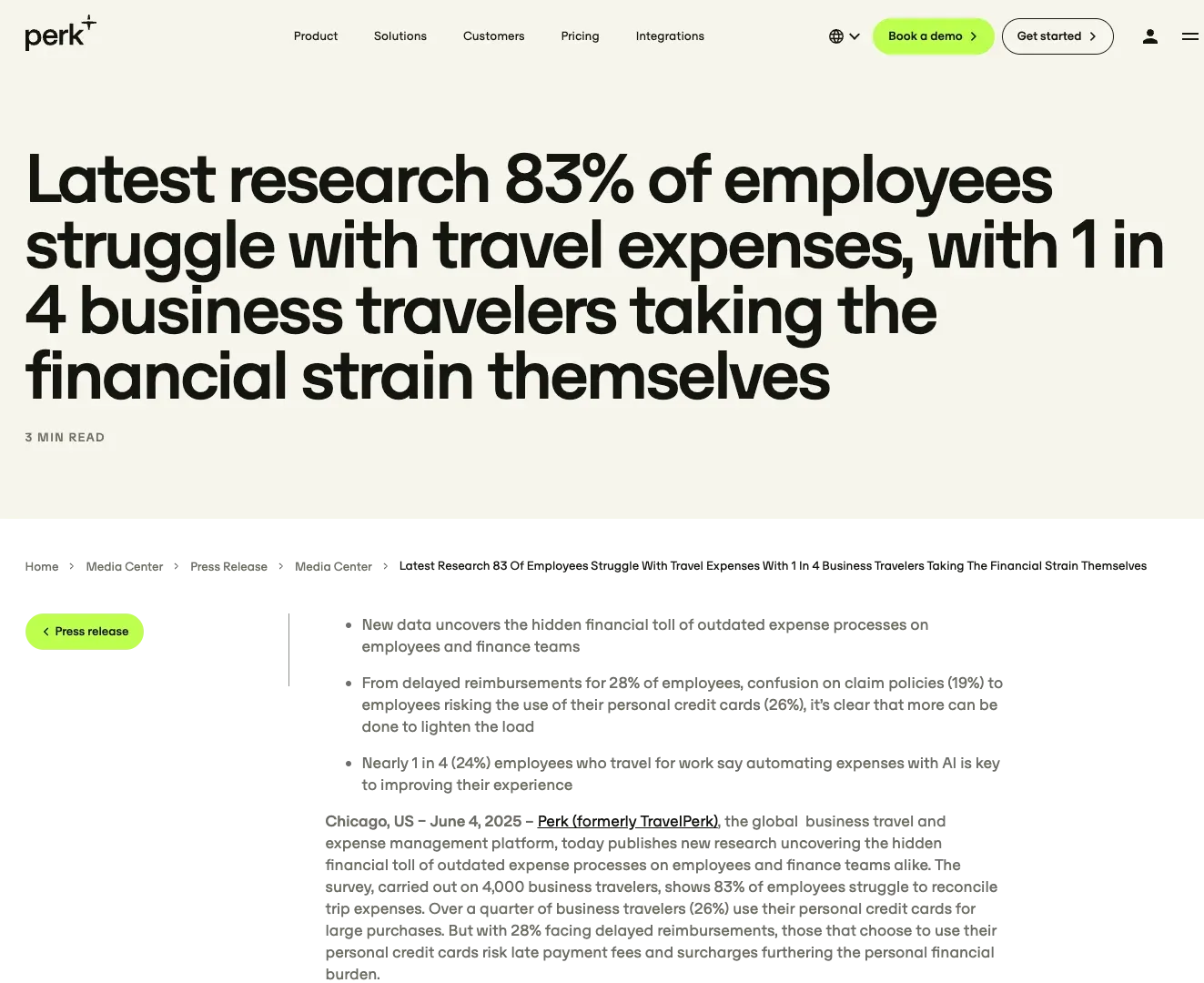
- 25% of business travelers admit to losing receipts while traveling, and 83% struggle to reconcile trip expenses. (Perk, 2025)
- 24% of business travelers say they don't have time to submit expense claims, and another 24% say the process is too complicated. (Perk, 2025)
- 28% of business travelers face delayed reimbursements, and 26% put large purchases on a personal credit card. (Perk, 2025)
Employees Paying Out of Pocket
- 58% of European employees worry they're losing money on unclaimed expenses because of missing receipts or forgetting to submit. 46% don't bother claiming small amounts at all. (SAP Concur, 2022)
- 40% of US employees have paid fees or interest on a personal card because of a business purchase, and 19% have delayed their own bills while waiting to be reimbursed. (Emburse, 2024)
- 29% of employees at corporate offsites paid out of pocket and filed expense reports. Only 25% used a corporate card. (Emburse, 2025)
What an Expense Report Costs
- $58 is the average cost to process an expense report, and one takes 20 minutes to complete. These are GBTA's most recent figures. (GBTA, 2015)
- 19% of expense reports contain errors or missing information, costing $52 and 18 minutes to fix each one. (GBTA, 2015)
- 63% of travel buyers still submitted paper receipts in 2015, and 81% in Europe. (GBTA, 2015)
Receipts for Small Businesses and Freelancers
For freelancers and small business owners, receipts are a tax problem before they're anything else.
The IRS's own numbers show that keeping records takes longer than filling in the return.
Receipts at Tax Time
- 35% of US self-employed workers, freelancers and small business owners say organizing receipts is their biggest tax-related headache, ahead of understanding tax law (33%) and finding deductions (32%). (FreshBooks, 2025)
- 21 hours and $610 is the average burden of a US tax return for business filers (Schedule C, E or F), against 8 hours and $160 for everyone else. (IRS, 2026)
- 10 of those 21 hours go to recordkeeping, the largest single part of the burden. Non-business filers spend 3 hours on it. (IRS, 2026)
- 29% of US individual tax returns are business returns. (IRS, 2026)
Time Spent on Admin
- 22 hours a month is how long US small business owners spend on financial management. (Xero, 2026)
- 25 hours a week goes to manual data entry or reconciling data across apps at US businesses with 10 to 99 employees. (Intuit QuickBooks, 2024)
- 44 hours and £4,500 a year is what the average UK small firm spends on tax compliance, nearly £25 billion across the economy. (Federation of Small Businesses, 2025)
- 46% of the working week is all the time UK sole traders and micro-business leaders spend on their core job. The rest goes to admin and other work. (Xero, 2024)
- 18th of 75: federal paperwork ranks 18th of 75 problems for US small business owners, and 13.2% call it critical. (NFIB, 2024)
Receipts and the Tax Gap
Tax authorities measure the money that never shows up. Missing records keep coming up as one of the reasons.
United States
- $696 billion is the IRS's projected gross tax gap for tax year 2022. The voluntary compliance rate is 85.0%. (IRS, 2024)
- 55% of income with little or no third-party reporting, such as sole proprietor income, is misreported. The rate is 6% for income with information reporting but no withholding, and 1% for wages. (IRS, 2024)
- $194 billion (28%) of the gross tax gap comes from underreported individual business income, the largest single contributor. Nonfarm sole proprietor income alone accounts for $117 billion. (IRS, 2024)
United Kingdom
- 62% of the UK tax gap comes from small businesses, the largest share of any customer group. The total UK tax gap is £59.2 billion, or 6.4% of liabilities, in 2024 to 2025. (HMRC, 2026)
Australia
- 17.4% ($27.2 billion) is the ATO's preliminary estimate of Australia's small business income tax gap for 2022 to 2023. (ATO, 2026)
- 35% of small businesses in the ATO's random enquiry program tried to report correctly but made mistakes, usually because of poor record keeping. Only 54% got it right. The ATO lists "faded receipts or no digital backups" among the problems. (ATO, 2025)
- $3.7 billion: work-related expenses are the largest single contributor to Australia's tax gap for individuals not in business, and poor record keeping is one of the named causes. (ATO, 2025)
- 44% of adjustments in the ATO's random audit sample were to work-related expenses. Claims that "appeared legitimate" were rejected because there were "no receipts, logbook or diary entries." (ATO, 2025)
How Long to Keep Receipts by Country
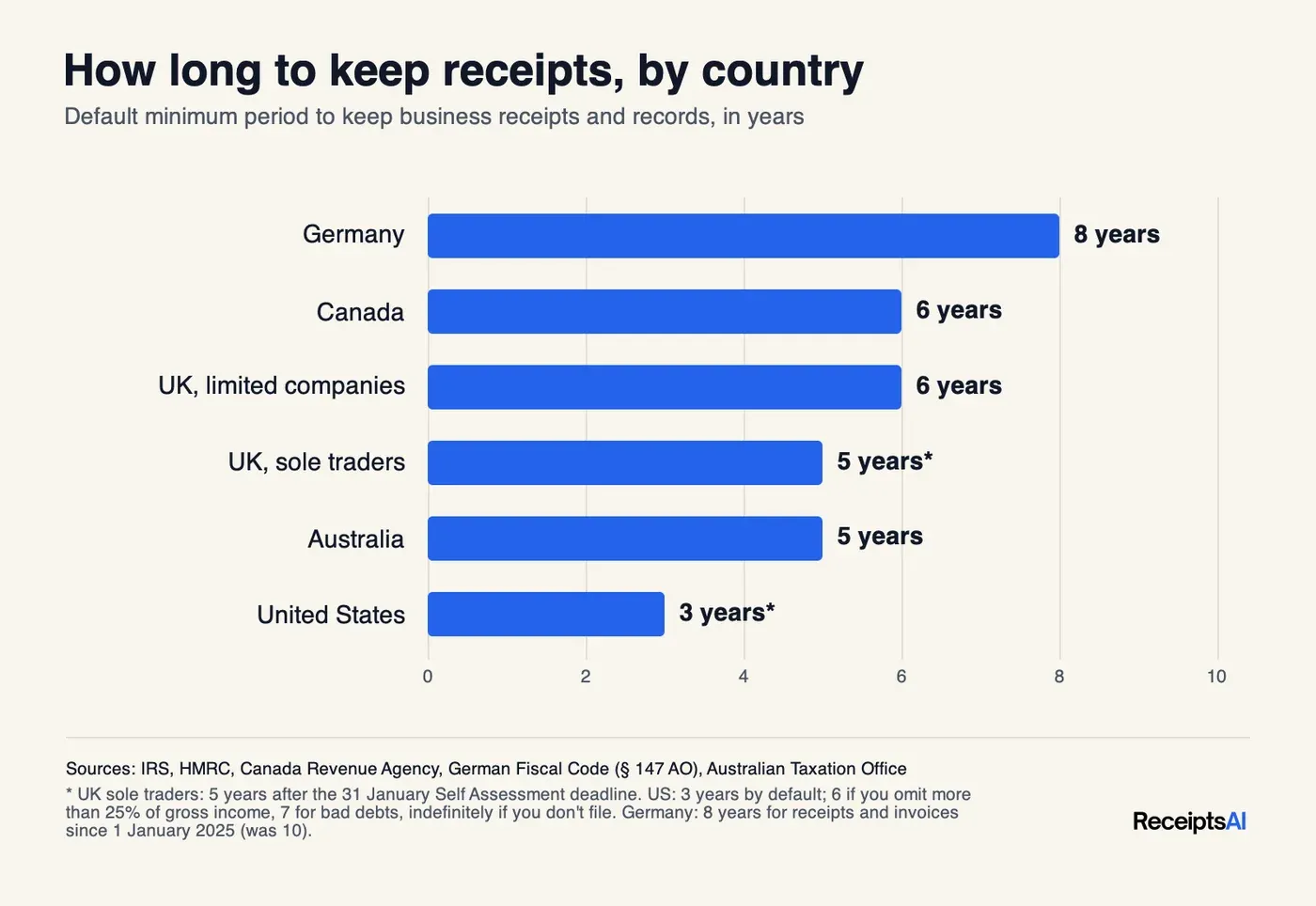
Keep it for three years. Or five. Or eight. It depends where you file.
And the rules keep moving: Germany cut its period for receipts from 10 years to 8 in 2025, and the UK is phasing in digital records for the self-employed.
United States
- 3 years is the IRS's default period to keep records. It's 6 years if you omit more than 25% of gross income, 7 years for a bad debt or worthless securities, and indefinitely if you don't file or file a fraudulent return. (IRS)
- 4 years is how long to keep employment tax records. (IRS)
- 4 things make a receipt adequate for the IRS: the amount, date, place and essential character of the expense. (IRS Publication 463)
- Under $75: no receipt is needed for travel, gift or car expenses, except lodging. (IRS Publication 463)
- No estimates: if you've lost a travel, gift or car receipt, you can't fall back on the Cohan rule, the 1930 court decision that let taxpayers estimate expenses they couldn't document. (26 CFR § 1.274-5T)
- Scanned receipts are accepted if the system meets Rev. Proc. 97-22, and originals can be destroyed once the system is tested. (IRS Publication 583)
United Kingdom
- 5 years after the 31 January Self Assessment deadline is how long sole traders must keep records. (GOV.UK)
- 6 years for limited companies, and 6 years for VAT records. (GOV.UK; HMRC VAT Notice 700/21)
- £3,000 is the fine HMRC can give a limited company that doesn't keep accounting records. (GOV.UK)
- Under £50: petty cash purchases (VAT inclusive) can be recorded as a total, up to £500 per entry. (HMRC VAT Notice 700/21)
- Scanned invoices can replace the original if the image shows all the VAT details. (HMRC VAT Notice 700/21)
- £50,000 is the income threshold for Making Tax Digital for Income Tax from April 2026, dropping to £30,000 in April 2027 and £20,000 in April 2028. (GOV.UK)
Canada
- 6 years from the end of the last tax year the records relate to. (Canada Revenue Agency)
- Destroying records early without the CRA's permission can lead to prosecution. (Canada Revenue Agency)
- Electronic records must be kept in electronic form, even when a paper copy exists. (Canada Revenue Agency, IC05-1R1)
Germany
- 8 years for receipts and invoices since 1 January 2025, down from 10. Books and annual accounts still need 10 years. (§ 147 AO)
- 1 January 2025: every German business must be able to receive e-invoices. Paper invoices are allowed until the end of 2026, or 2027 for turnover of €800,000 or less. (German Federal Ministry of Finance; § 27 UStG)
- A plain PDF no longer counts as an e-invoice. The law requires a structured electronic format that can be processed automatically. (§ 14 UStG)
Australia
- 5 years for most business records. (ATO)
- Over $300: once work-related claims add up to more than $300, you need written evidence for the whole amount, not just the part above $300. (ATO, 2026)
- Records can be kept on paper or electronically. (ATO)
Expense and Receipt Fraud
Expense fraud is rarely a big heist. It's a padded taxi fare or a dinner that never happened, repeated month after month.
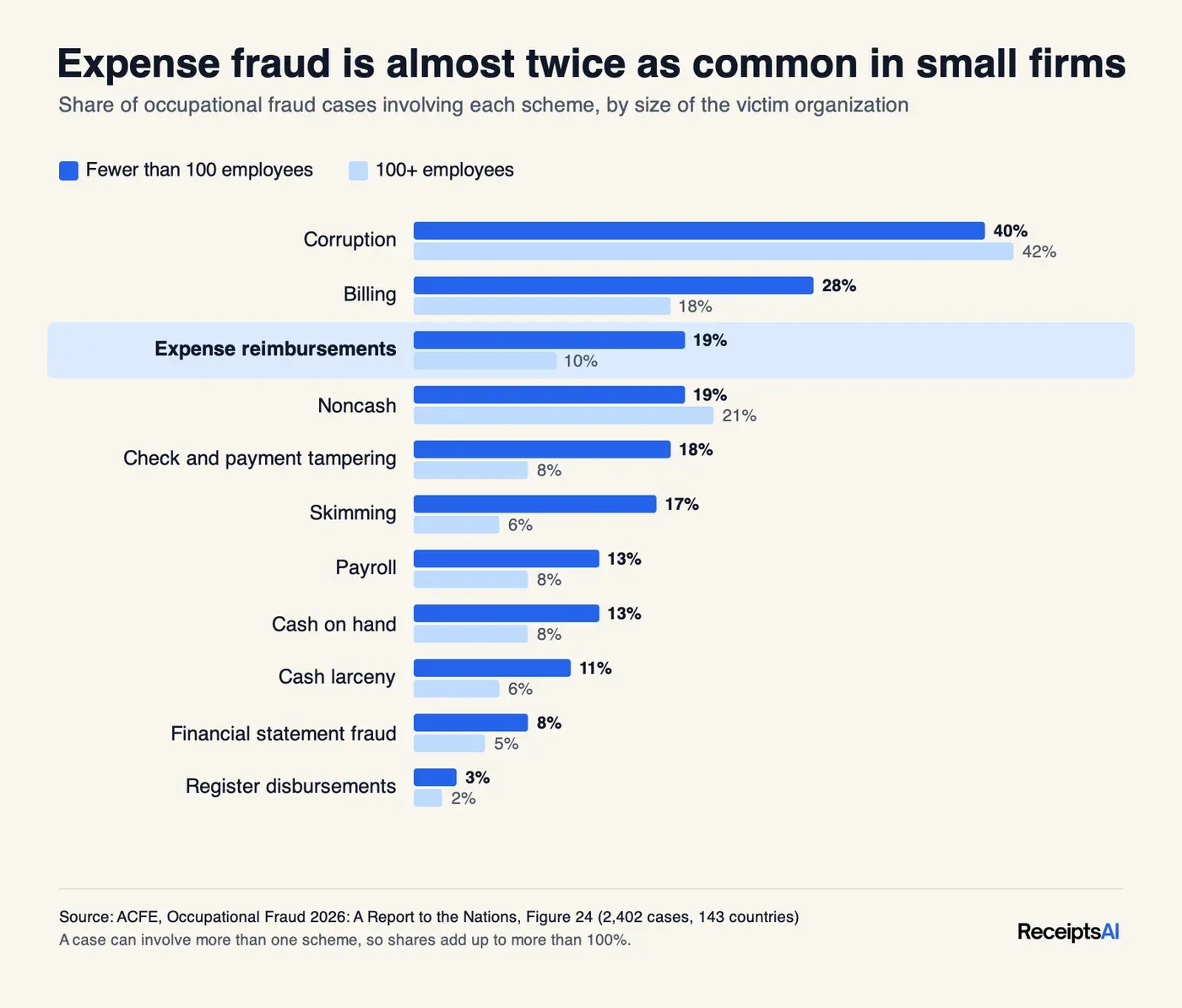
It runs for a long time before anyone notices, and it hits small businesses hardest.
Expense Reimbursement Fraud
- 19% of fraud cases at organizations with fewer than 100 employees involved expense reimbursements, almost double the rate at larger organizations (10%). (ACFE, 2026)
- 13% of occupational fraud cases involved expense reimbursement schemes, with a median loss of $36,000. (ACFE, 2026)
- 18 months is the median time an expense reimbursement scheme runs before it's caught. For fraud overall it's 12 months. (ACFE, 2026)
- $1,900 a month is the median loss from expense reimbursement schemes, the second-slowest-moving scheme type. (ACFE, 2026)
- $126,000 is the median fraud loss at organizations with fewer than 100 employees, the highest of any size group. (ACFE, 2026)
- About one in four small businesses has a fraud hotline, against 85% of larger organizations. (ACFE, 2026)
Non-Compliant Expense Claims
- 14% of expenses were non-compliant across more than 10 million expenses processed in 2024 and 2025: 9% unintentional (errors, missing data) and 5% intentional (duplicates, falsified claims). (Rydoo, 2025)
- 15 to 20% of expense reports contain non-compliant spend on average. Most of it comes from errors such as duplicate transactions or missing itemized receipts, not bad intent. (SAP Concur, 2025)
Retail Return Fraud
- 2% of US retail returns in 2025 were fraud, worth $14 billion of $706 billion in returns. That includes fake receipts and returning stolen goods. (Appriss Retail, 2026)
- 9.6% of return dollar volume ($68 billion) came from returns without a receipt, which Appriss calls "home to the most blatant fraud." (Appriss Retail, 2026)
- 9% of all returns are fraudulent, by retailers' own estimates. Total 2025 returns were projected at $849.9 billion, or 15.8% of sales. (NRF and Happy Returns, 2025)
- 48% of retail executives have seen returns made with counterfeit receipts or e-receipts. (Appriss Retail and Deloitte, 2024)
AI-Generated Fake Receipts
This is the fastest-moving number on the page.
In March 2025, none of the fake receipts AppZen's audits flagged were made with AI. By May 2026, most of them were.
What Expense Audits Catch
- AI-generated documents went from 0% of flagged fraudulent receipts in March 2025 to 70.8% by mid-May 2026, across 1,471 fake receipts from 745 employees at 174 companies. (AppZen, 2026)
- April 2026 was the first month AI-generated fakes overtook template-based fakes on AppZen's platform. (AppZen, 2026)
- About $100 is the average value of an AI-generated fake receipt, below the $182 average for older template-based fakes. The 1,471 fakes totaled $148,143. (AppZen, 2026)
What Employees Admit
- 40% of US employees have used AI to generate a fake receipt for a business expense, and 29% of UK employees have. (Emburse, 2026)
- 19% of US employees used AI to fabricate a purchase entirely, 15% to inflate a real one, and 6% to replace a lost receipt. (Emburse, 2026)
What Finance Teams and CFOs Say
- 32% of finance professionals say they wouldn't recognize a fake expense report, and 30% have seen a rise in faked receipts since early 2024. (Medius, 2025)
- 42% of finance professionals have suspected a colleague of submitting a fake or altered receipt, and 34% have been pressured to approve an expense that didn't look legitimate. (Medius, 2025)
- 67% of CFOs think it's at least somewhat likely employees are using AI to falsify expenses or receipts, and 9% know it's happening. (SAP Concur, 2025)
- 55% of CFOs expect AI to catch more expense errors and potential fraud than their team does today. (SAP Concur, 2025)
Receipt OCR Accuracy
Reading a receipt sounds easy until you meet one: crumpled, faded, half torn, and laid out differently by every merchant.
Here's how well machines actually do it, according to the research benchmarks.
Receipt OCR Benchmarks
- 1,000 scanned receipts make up SROIE, the standard academic benchmark for receipt reading. (ICDAR, 2019)
- 90.49% was the best score for extracting key fields (company, date, address, total) in the 2019 SROIE competition. Only one of 18 methods beat 90%. (ICDAR, 2019)
- 97.46 F1 is LayoutLMv3's score on CORD, a 1,000-receipt dataset, after fine-tuning. (Microsoft, 2022)
How AI Models Read Receipts
- 47.49 F1 was GPT-4o's score on SROIE when reading receipt images directly. "Even powerful GPT-4o still struggle[s]" with document extraction, the researchers note. (Zhang et al., AAAI, 2025)
- 87.46% accuracy was the best result on SROIE receipts in a 2025 benchmark when models read the image directly (Gemini 2.5 Pro). Converting to text first capped accuracy at 47.00%. (Fraunhofer IAIS, 2025)
- 98.52% F1 on SROIE and 98.83% on CORD were reached by Amazon researchers using Claude 3.5 Sonnet, few-shot examples and document segmentation. (Amazon, 2025)
Manual Data Entry Errors
- 0.29% of fields contain errors with single manual data entry, against 0.14% with double entry and 6.57% when data is copied from records. This comes from a meta-analysis of clinical research data, the best primary evidence on manual entry error rates. (Garza et al., 2024)