

You open the bank feed at month-end and already know what's coming. Card charges with no receipts. Reimbursements buried in email. A few vendor names you don't recognize. Maybe a spreadsheet someone updated halfway, then abandoned. The problem isn't the report. The problem is the workflow behind it.
A good monthly expense report fixes more than reimbursement. It gives you a clean record of what was spent, why it was spent, how it was paid, and whether it belongs in your books this month. That matters if you want faster closes, fewer bookkeeping cleanups, and reports you can trust.
Most small businesses don't need a fancier spreadsheet first. They need a tighter process from capture to reconciliation to review.
Table of Contents
- What a Modern Monthly Expense Report Really Includes
- The Foundation Gathering and Categorizing Your Expenses
- Reconciliation Turning Raw Data into a Verified Report
- Common Expense Report Pitfalls and How to Avoid Them
- How to Automate Your Monthly Expense Reporting Workflow
- Frequently Asked Questions About Expense Reports
What a Modern Monthly Expense Report Really Includes
A monthly expense report isn't just a receipt log. Modern templates commonly standardize 10+ data fields such as employee or department name, expense date, vendor, category, amount, tax, currency, business purpose, cost center or GL code, receipt reference, and approval status because those fields support reimbursement, accounting, and audit readiness in one workflow, as outlined in this guide to building a monthly expense report.
If your current report only shows date, description, and total, it's too thin to support month-end work. You can't reliably separate reimbursable expenses from card charges. You can't review tax treatment properly. You also can't answer basic questions later without digging back through email and statements.
The report is a control document
A strong report does three jobs at once:
- It supports reimbursement by showing who paid and what needs to be repaid.
- It supports bookkeeping by giving your bookkeeper the fields needed to post the transaction correctly.
- It supports review by making exceptions visible before they turn into cleanup work.
Practical rule: If someone outside the transaction can't understand the expense from one line item and one receipt attachment, the report isn't finished.
Small businesses often skip fields like cost center, business purpose, or approval status because they sound corporate. That's a mistake. A two-location shop, a contractor with multiple jobs, or an agency with recurring clients all benefit from knowing which expense belongs where.
If you need a clean starting point for categories that connect to reporting, this breakdown of business expense categories is useful.
Essential fields for an audit-ready expense report
| Field | Description | Why It Matters |
|---|---|---|
| Employee or department name | Who incurred the expense | Ties spending to responsibility and reimbursement |
| Expense date | The transaction date | Helps place the expense in the correct period |
| Vendor | The merchant or supplier | Makes review and coding easier |
| Category | Travel, software, meals, supplies, and similar | Supports consistent reporting |
| Amount | The total paid | Core value for reimbursement and posting |
| Tax | Sales tax, VAT, or GST amount | Needed for compliance and accurate accounting |
| Currency | Original transaction currency | Important for cross-border spending |
| Business purpose | Why the expense was incurred | Provides context for approval and audit review |
| Cost center or GL code | Account or operational bucket | Connects the expense to your books |
| Receipt reference | Link, file name, or attachment ID | Proves the expense occurred |
| Approval status | Pending, approved, rejected, adjusted | Keeps workflow visible |
A useful monthly expense report also includes subtotals by category, a reimbursement total, and notes for exceptions. Those aren't cosmetic extras. They help you spot unusual spend, identify missing information, and keep the close from turning into a detective job.
The Foundation Gathering and Categorizing Your Expenses
Messy reports start long before month-end. They start the moment someone puts a paper receipt in a pocket, forwards an invoice to the wrong inbox, or tells themselves they'll remember what that charge was later.
That doesn't work for long. In the United States, the average household spent $78,535 per year, or $6,545 per month, according to the Bureau of Labor Statistics data cited by InCharge's overview of average monthly expenses. A business handles recurring spend the same way. Small omissions pile up faster than owners expect.
Build one capture habit
You need one intake method for every expense source. Not three half-used methods.
Use a simple rule set:
- Paper receipts get photographed or scanned the same day.
- Email invoices go to one bookkeeping inbox or folder.
- Card transactions are reviewed against receipts regularly, not only at month-end.
- Cash purchases need a receipt plus a short note about business purpose.
If you're tightening your process from scratch, this guide on effective small business expense tracking gives a practical overview of how to keep capture and review from drifting apart.
A receipt collected late is usually a receipt collected badly.
The biggest shift is behavioral. Don't treat expense capture as admin you batch later. Treat it like documentation created at the moment of spend. That one habit removes most of the confusion that shows up at close.
For businesses that still rely on phone photos and scattered uploads, comparing a few receipt scanner apps for small businesses can help you choose a capture method people will use.
Categories must stay consistent
Categorization is where many small businesses ruin their own reports. Not because the categories are hard, but because they keep changing names and meanings.
A workable framework is usually enough:
- Operating costs such as rent, utilities, subscriptions, and software
- Sales and marketing such as ads, printing, and events
- Travel and meals for transport, lodging, and client-facing spend
- Office and equipment for supplies, devices, and work tools
- Professional services for contractors, bookkeeping, legal, and consultants
What matters most is consistency. If one person books Zoom under software, another under admin, and a third under office expense, your report stops being useful. The totals may still add up, but the story your numbers tell becomes unreliable.
A clean monthly expense report should let you answer one question quickly: where did the money go this month?
Reconciliation Turning Raw Data into a Verified Report
An unreconciled monthly expense report is only a draft. It may look complete, but until each line agrees with the supporting records, it's not something I'd trust for reimbursement, review, or closing the books.
The standard process is a three-phase cycle of data aggregation, validation and categorization, and final reconciliation against bank statements. Manual processing costs roughly $20.65 per report, and a common pitfall is 15-20% data incompleteness when reports are batched at month-end, according to Precoro's expense report management guide.

Use a three-way match
For most small businesses, reconciliation comes down to one discipline. Match each expense across three records:
The receipt or invoice
This proves what was purchased, when, and from whom.The transaction log or expense report line
This shows how the expense was categorized and whether it's reimbursable, paid by card, or flagged as an exception.The bank or card statement
This confirms the money left the account.
If one of those three doesn't line up, stop there. Don't push the report through and hope to fix it later. That's how duplicate entries, missing reimbursements, and period errors creep into the books.
Churches, nonprofits, and small service businesses often face the same reconciliation discipline, even if the transaction types differ. This guide on essential steps for church reconciliation is a useful reminder that the method matters more than the industry.
A simple real-world example
Take a business trip with four expenses: a hotel charged to the corporate card, a taxi paid personally, a client meal paid on another company card, and a software subscription billed automatically during the trip.
That set needs sorting before posting:
- Corporate card charges belong in the report for review, but not for employee reimbursement.
- Out-of-pocket items need reimbursement status clearly marked.
- Recurring subscriptions may be valid expenses but still need to be assigned to the correct month and category.
- Any exception such as a missing receipt or unclear business purpose needs a note before approval.
Reconciliation isn't data entry. It's the point where you decide whether the record is true.
When owners skip this step, they usually still get a report. They just don't get a verified one. And that's the difference between a report you can act on and one that creates more cleanup next month.
Common Expense Report Pitfalls and How to Avoid Them
Most bad monthly expense reports aren't caused by one big failure. They come from small habits that nobody corrected early. A missing receipt here. A vague memo there. A late submission that forces someone to guess what happened.
One preventable issue is the lack of standardized templates. That causes 30% of manual reports to be rejected for missing required fields like tax applications or budget codes, while automated systems that enforce policies can reduce processing time from 45 minutes to under 5 minutes per report, according to Brex's expense report overview.
What breaks the process
Here's what I see most often in small businesses:
Missing receipts
The expense may be real, but without proof, review turns into back-and-forth.Incorrect categorization
The total spend may be accurate while the reporting is wrong. That makes budget review less useful.Late submissions
Expenses arrive after the books are nearly closed, so your team either delays the close or posts with incomplete information.Duplicate entries
This happens when someone submits a receipt manually after the card feed already captured the charge.Policy violations
These don't always mean abuse. Often, they mean nobody explained what counts as acceptable support or approval.
What actually prevents repeat mistakes
Don't rely on reminders alone. Build rules into the process.
- Require capture at purchase time so people aren't reconstructing the month from memory.
- Use predefined categories with dropdowns or locked coding choices where possible.
- Set a submission cutoff that leaves time for review before month-end close.
- Check duplicates during review by comparing vendor, date, and amount before approval.
- Define exception handling clearly so a missing receipt, mixed-use purchase, or unusual charge gets routed for review instead of ignored.
Field note: “I lost the receipt” is usually a process problem, not a character problem.
That distinction matters. If your process depends on everyone being unusually organized, it will fail. If your process assumes normal human behavior and makes documentation easy, it will hold up much better.
How to Automate Your Monthly Expense Reporting Workflow
Most business owners don't need more effort. They need fewer manual touchpoints.
Many guides on monthly expense reports stop at fields and templates but don't solve the harder operational problem of reconciling card charges, reimbursements, and policy exceptions. Automation-focused workflows that use AI extraction to bridge that gap are becoming essential for an efficient month-end close, as noted in HoneyBook's expense report example guide.

What automation should handle
A useful automation setup should take over the repeatable parts of expense reporting:
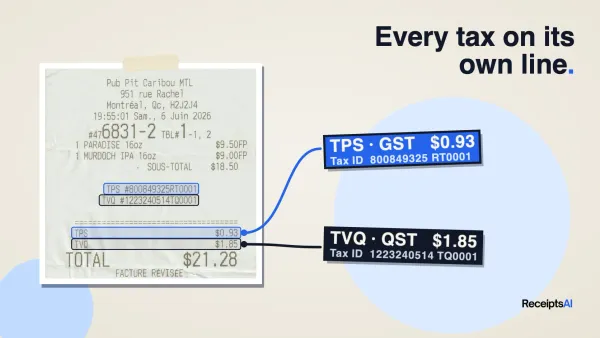
- Receipt capture and extraction so dates, vendors, totals, and tax details don't need to be typed by hand
- Document organization so receipts and invoices are searchable later
- Category suggestions or rules to keep coding consistent
- Duplicate detection before the report is finalized
- Export-ready reporting for Excel, CSV, or accounting handoff
That's where tools start earning their keep. For example, ReceiptsAI's automated data entry workflow is built around pulling structured data from receipts, invoices, PDFs, spreadsheets, and bank documents so the bookkeeping record starts closer to complete.
Automation also matters outside the expense tool itself. If your ops team already runs approvals or project tracking elsewhere, it helps to automate monday.com and Xero processes so expense data doesn't get trapped between systems.
Where tools fit into your month-end close
The right tool doesn't replace review. It reduces the amount of avoidable manual work before review starts.
Use this as the dividing line:
- Software should capture, extract, sort, and flag
- A human should approve, explain exceptions, and make final coding decisions when context matters
That balance works well for growing businesses. You keep control over the accounting outcome without paying people to retype receipts.
A walkthrough helps make that more concrete:
If your monthly expense report still depends on one person chasing documents for half a day, automation isn't a luxury. It's the practical fix for a process that's already costing you attention, accuracy, and closing time.
Frequently Asked Questions About Expense Reports
A monthly expense report becomes far more useful when you treat it as a management tool, not just a reimbursement file. Modern businesses want to use expense data for cash-flow visibility and forecasting, while traditional templates tend to stop at static totals and summaries, as discussed in Billdock's article on monthly expense report templates.
Should I create one report for the whole business or separate ones
Use separate reports when different people incur expenses or when different locations, departments, or projects need review. Use a consolidated summary afterward for owner review.
That keeps approval cleaner. It also makes it easier to spot who needs to fix what instead of mixing everything into one giant worksheet.
How do I handle mixed payment methods
Mark payment method on every line. At minimum, separate:
- corporate card charges
- owner-paid expenses
- employee reimbursements
- direct vendor invoices
That one distinction prevents a lot of confusion. Without it, businesses often reimburse an expense that was already paid from the company account, or fail to reimburse a valid out-of-pocket purchase.
What should I review before I finalize the month
Review the report like a decision tool, not just a filing exercise.
Check for:
- Missing support attached to any line item
- Unusual category spikes that may affect cash planning
- Late-posted expenses that belong in another period
- Recurring charges that need closer scrutiny
- Exceptions that need explanation before approval
A finished monthly expense report should help you answer practical questions. Which categories are rising. Which vendors are recurring. Which jobs or teams are spending more than expected. That's where the report starts doing real work for the business.
If you want a simpler way to capture receipts, organize supporting documents, extract key fields, and produce export-ready monthly expense reports, ReceiptsAI is built for small businesses and bookkeeping workflows that need less manual cleanup.