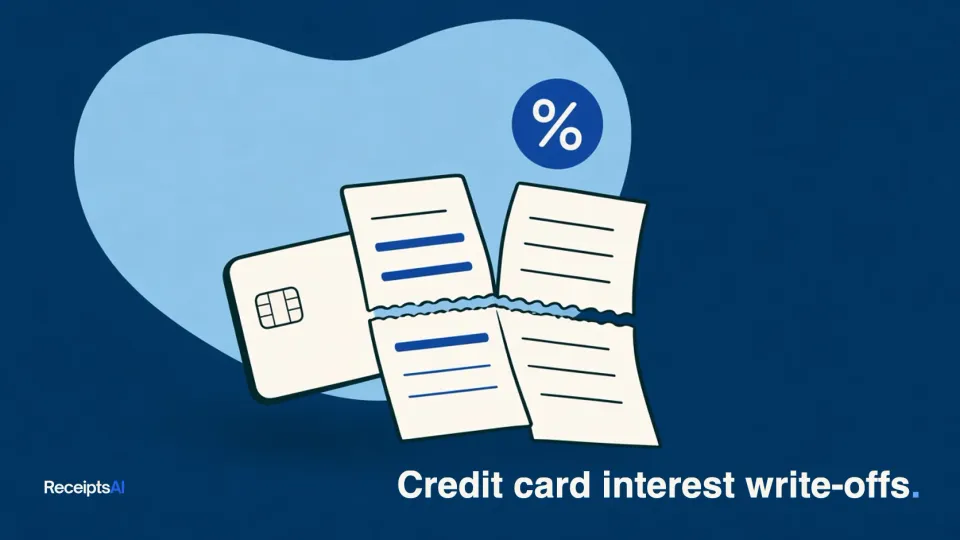

Personal credit card interest is not deductible, while business credit card interest can be deductible when it relates to ordinary and necessary business expenses. The difficult middle ground is a mixed-use card, where only the business portion of the interest qualifies.
A sole proprietor often discovers the problem while reviewing a monthly statement: business software, a client meal, groceries, a family dinner, and a conference flight all appear on the same account. The card may carry a business name, but the statement doesn't separate the interest into neat tax categories.
That's why the answer to can you write off credit card interest isn't determined by the card's label. The questions are what each charge paid for, who is legally responsible for the debt, and whether the business portion can be supported with records. The general rule is simple, but applying it to a blended balance requires more care.
Table of Contents
- The Mixed-Use Card Problem Most Guides Skip
- How the IRS Decides Which Interest Qualifies
- Personal, Business, and Investment Interest Compared
- Splitting Mixed-Use Cards the Right Way
- Schedule C, Form 4952, and the Section 163(j) Cap
- Common Mistakes That Cost Real Money
- Three Quick Worked Examples
The Mixed-Use Card Problem Most Guides Skip
A freelance consultant uses one rewards card for nearly everything. The statement includes project-management software, a hotel for a client engagement, groceries, a streaming subscription, and a personal medical purchase. At the bottom, the issuer reports one interest charge.
The issuer doesn't tell the consultant which part is business interest. The taxpayer has to build that allocation from the transactions that created the balance.
Why the card label isn't enough
A card marketed as a business card doesn't turn personal spending into a business expense. Likewise, using a personal card to pay for a legitimate business purchase doesn't automatically destroy the business connection. The tax treatment follows the underlying transaction, not the plastic in the wallet, as explained in this practical discussion of business credit card interest and traceability.
That distinction matters because a blanket answer can produce two opposite mistakes. Some owners claim nothing, even though identifiable business charges generated part of the interest. Others deduct the full statement interest because every charge ran through an account used for work.
Bookkeeping rule: Treat the card statement as raw evidence, not as the finished tax deduction.
The workable approach starts with transaction-level classification. Mark each charge as business, personal, or uncertain. Then preserve the statement, receipts, invoices, and notes that explain the business purpose. If a purchase is partly personal, record the business portion rather than forcing it into an all-or-nothing category.
What you should be able to answer
By the end of a careful review, you should know:
- What created the interest: Which business transactions contributed to the balance?
- What belongs in the deduction: Which charges were ordinary and necessary for the trade or business?
- How the split was calculated: Did you use a repeatable allocation method?
- Who owes the debt: Is the taxpayer claiming the deduction also liable for the card balance?
- What survives review: Can another person follow the calculation from the statement to the tax return?
A dedicated business card makes this easier, but it isn't a substitute for records. A mixed-use account can still produce a defensible partial deduction when the allocation is reasonable, consistent, and supported.
How the IRS Decides Which Interest Qualifies
The starting point is the personal-versus-business distinction. Personal credit card interest generally falls into nondeductible personal interest, while interest connected to a trade or business may qualify as business interest. The modern U.S. personal-interest rule has applied since the 1980s, following the elimination of the broad personal-interest deduction described in TurboTax's explanation of credit card interest deductions.
The analysis works best as a sequence of questions.
First, identify the use of the borrowed money
Look through the purchases that produced the balance. A charge for business software, inventory, advertising, or an ordinary client-related cost may support business treatment. Groceries, household purchases, and personal entertainment don't become deductible because they appear on a business-branded card.
The phrase ordinary and necessary is central. The expense must fit the conduct of the trade or business and make practical sense for that activity. A business owner should be able to explain the charge without relying on the card's name or a vague statement that it was “for work.”

Next, confirm who is liable for the debt
For sole proprietors and small firms, the taxpayer's liability matters. The deduction isn't based solely on who benefited from a purchase or whose name appears on an internal bookkeeping file. The person or entity claiming the interest should have a genuine obligation to repay the card debt.
Finally, connect the interest to the qualifying spending. Interest doesn't inherit a business character from the account as a whole. A blended balance can contain deductible business-related interest and nondeductible personal interest at the same time.
Understanding the underlying mechanics also helps. A plain-language explanation of how interest affects your debt can clarify why an interest charge reflects the cost of carrying a balance, while tax treatment depends on the purpose of the borrowed funds.
The IRS question isn't “Was this a business card?” It's “What did the debt finance, and can the taxpayer prove it?”
That framing prevents the most common overclaim. It also gives a sole proprietor a practical audit trail: transaction, business purpose, liability, allocation, and reported expense.
Personal, Business, and Investment Interest Compared
Credit card interest usually fits one of three practical categories. Personal interest relates to household consumption. Business interest relates to carrying on a trade or business. Investment interest relates to debt used to acquire or carry taxable investments and follows a separate limitation framework.

| Interest category | Typical use | General treatment | Filing path |
|---|---|---|---|
| Personal | Household and private purchases | Generally nondeductible | Not a business write-off |
| Business | Trade or business purchases | May be deductible when properly connected and documented | Often Schedule C for a sole proprietor |
| Investment | Debt used for taxable investments | May be deductible subject to investment-income limits | Form 4952 may apply |
Personal interest
Interest on a card used for groceries, clothing, family travel, household services, or other private spending is personal interest. Itemizing deductions doesn't turn that balance into a business expense. The same conclusion applies when a personal purchase appears on an account that the owner informally calls a business card.
Don't confuse credit card interest with other borrowing categories. For example, someone evaluating whether auto loan interest may qualify for a tax deduction needs to apply the rules for that specific type of debt, not transfer the credit card rule automatically.
Business interest
Interest associated with qualifying business spending may be deducted as a business expense, subject to documentation and any broader business-interest limitations. A card used exclusively for business purchases creates a cleaner accounting trail because the entire balance is connected to the same type of activity.
A card used for both purposes requires allocation. The business charges may qualify, but the personal charges don't. The result is often a partial deduction rather than a complete yes or no.
Investment interest
Investment interest is a different lane. If card debt was used to acquire or carry taxable investments, the expense may flow through Form 4952, where the deduction is tied to net investment income. That treatment shouldn't be reported as ordinary business interest merely because the taxpayer owns a business.
A useful decision rule is direct: household purpose points to personal interest, operating purpose points to business interest, and taxable-investment purpose points to investment interest. When one statement contains multiple purposes, classify the transactions before choosing the form.
Splitting Mixed-Use Cards the Right Way
The harder challenge with mixed-use cards is making the division credible. A defensible allocation begins with the transactions that created the balance, not with a convenient percentage applied after the fact.
Export every transaction covered by the interest charge. Classify each purchase as business or personal, then connect business entries to receipts, invoices, calendars, project records, or other supporting documents. The goal is a ledger that explains both the amount and the reason for each classification.

Three allocation methods
By transaction count is simple, but it can misstate the balance. Ten small personal purchases and one large business purchase do not represent equal shares. Counting transactions may serve as an internal check, yet it is weak as the primary method when purchase amounts differ substantially.
By dollar value usually provides the stronger explanation because interest relates to the amount carried. Add the business and personal charges included in the relevant balance, then calculate the business share from the documented amounts. Match the calculation to the statement period and account for credits, refunds, payments, and balance transfers.
By fixed percentage can be reasonable when it reflects a documented spending pattern and receives periodic review. Do not choose a percentage solely because it creates a larger deduction. Retain the transaction history that established the percentage and explain why it remains appropriate.
What records make the split defensible
A reviewer should be able to begin with the statement and reproduce the allocation. Keep these records:
- Tagged transaction exports: Preserve dates, merchants, amounts, and classifications.
- Receipts and invoices: Connect larger or unusual charges to a business purpose.
- Category rules: Document treatment of software, meals, travel, supplies, and ambiguous merchants.
- A method statement: State whether the allocation uses dollar value, transaction count, or a fixed percentage.
- Reconciliation notes: Explain refunds, disputed charges, credits, payments, and unresolved items.
A structured business-expense tracking workflow can centralize transaction evidence, but software cannot determine whether a purchase relates to the business. The owner still must make and support that judgment.
Predictable shortcuts weaken the file. Claiming the full interest charge, using a round business percentage without support, or treating every ambiguous merchant as business makes the allocation harder to defend. A smaller deduction supported by the statement and underlying records is safer than an inflated figure the transaction history cannot explain.
Schedule C, Form 4952, and the Section 163(j) Cap
Once the classification is complete, the filing path depends on the purpose of the interest and the taxpayer's structure.
A sole proprietor generally reports deductible business interest on Schedule C, alongside the other expenses of the trade or business. The underlying charges still need to meet the business-purpose test, and a mixed-use card requires the business portion to be separated before the amount reaches the return.
Investment interest follows a different route. When the debt financed taxable investments, Form 4952 may apply, and the deduction is limited by net investment income. That isn't the same calculation as allocating a business card between office supplies and groceries.
The larger-business limitation
Business treatment doesn't always mean the entire amount is currently deductible. Under Internal Revenue Code Section 163(j), the IRS framework can limit many business-interest deductions to business-interest income plus 30% of adjusted taxable income, subject to exceptions for some small businesses and industries. QuickBooks' overview of credit card payments and business-interest limits describes the broader limitation issue.
The practical consequence is important. Two businesses can have the same card balance and the same APR, yet recognize different current deductions because their enterprise-level interest capacity differs. Excess interest may be carried forward rather than deducted immediately.
Recent coverage identifies gross-receipts thresholds around $31 million for 2025 and $32 million for 2026, with the applicable rules and exceptions requiring careful review. Those figures and the surrounding Section 163(j) treatment are discussed in this 2025 business-interest guide. Growing companies should evaluate the limitation across the relevant business structure instead of assuming a credit card charge is too small to matter.
| Interest category | Filer type | Tax form | Key limitation |
|---|---|---|---|
| Business interest | Sole proprietor | Schedule C | Must relate to qualifying business spending |
| Investment interest | Taxpayer with taxable investments | Form 4952 may apply | Limited by net investment income |
| Business interest subject to Section 163(j) | Larger or otherwise affected business | Business return schedules and supporting workpapers | Current deduction may be limited and excess may carry forward |
| Personal interest | Individual taxpayer | No business deduction | Generally nondeductible |
For a small firm, the immediate task is usually transaction classification and documentation. For a growing company, the calculation also needs an interest-limitation workpaper that considers other business interest, business interest income, adjusted taxable income, and applicable exceptions.
Common Mistakes That Cost Real Money
The most expensive errors usually come from treating a bookkeeping shortcut as a tax rule.
A business label on the account doesn't change personal spending. A card can be issued to a company and still contain groceries, family travel, or other private purchases. Conversely, a personal card can contain a legitimate business charge, but the owner must still prove the connection and allocate the related interest.

The errors to catch before filing
- Trusting the card name: “Business” printed on the account doesn't make every charge deductible.
- Taking the full interest amount: A mixed statement cannot support a full business deduction when personal spending contributed to the balance.
- Skipping the receipt trail: A merchant name alone may not explain what was purchased or why it served the business.
- Ignoring Section 163(j): A larger business may have a qualifying interest expense that still can't be deducted fully in the current year.
- Using an unexplained percentage: A rounded allocation without transaction support looks like an estimate rather than a calculation.
- Failing to reconcile payments and credits: Refunds and statement credits can change the balance used in the allocation.
A clean deduction has two parts: the tax position and the file that proves how you reached it.
Before filing, compare the card statement with the general ledger. Confirm that every business charge has a category, every unusual entry has a note, and the interest allocation agrees with the method you documented. Guidance on IRS receipt requirements for small businesses can help you build a more complete support file.
Ask yourself whether someone unfamiliar with the business could follow the calculation. If the answer is no, improve the records before claiming the deduction. Don't wait for an IRS question to discover that the percentage was based on memory.
Three Quick Worked Examples
A few scenarios show how the rule operates without relying on the card's branding.
A freelance designer uses one card only for design software, client travel, supplies, and other ordinary business costs. The designer is personally liable for the account, keeps statements and receipts, and reports the qualifying interest with business expenses on Schedule C. Because the card's charges are consistently business-related, the allocation is comparatively clean.
A sole proprietor uses the same card for business software and household groceries. The owner exports the statement, tags each charge, totals the business and personal portions, and applies a documented dollar-value method to the relevant interest. Only the supported business share reaches the business return, while the personal share remains personal.
A small LLC has genuine business interest but is approaching the Section 163(j) gross-receipts threshold. The company calculates the business-purpose interest first, then applies the broader limitation rather than deducting the entire amount automatically. Any amount not currently allowed is tracked for possible future treatment under the applicable carryforward rules.
The repeatable decision rule is straightforward: classify the spending, verify liability, allocate mixed use, preserve the evidence, and check for interest limits before filing. If the debt financed personal purchases, don't claim it as business interest. If it financed identifiable business costs, document the connection instead of assuming the answer is automatically no.
ReceiptsAI can extract transaction details from uploaded credit card statements and categorize expenses for bookkeeping and tax preparation, which can make mixed-use allocation easier to review. Visit ReceiptsAI to organize statements, receipts, and supporting records before you calculate your business-interest deduction.