

If your accounts payable process feels like a pile of emailed invoices, sticky-note reminders, supplier calls, and end-of-month guesswork, you're not alone. Small businesses often start AP with good intentions and a simple rule: “Pay bills on time.” Then the business grows, invoices arrive from more places, approvals get delayed, and nobody is fully sure what's due this week, what's disputed, or what already got paid.
That's when AP stops being a tidy admin task and starts affecting real decisions. You hesitate on cash spending because you don't trust the payable list. A vendor follows up on an invoice you thought was handled. Your bookkeeper finds the same bill in two folders. The problem isn't only paperwork. It's control.
A good accounts payable process gives you a reliable way to receive, verify, approve, pay, and record what your business owes. It turns “I think we're current” into “I know exactly what's pending, approved, disputed, and paid.”
Table of Contents
- Why Your Accounts Payable Process Matters More Than You Think
- What Is the Accounts Payable Process
- The 6 Core Steps of the AP Workflow
- Common AP Problems and Their Hidden Costs
- Key AP Metrics to Improve Performance
- Best Practices for AP Control and Efficiency
- How ReceiptsAI Automates the AP Process
Why Your Accounts Payable Process Matters More Than You Think
It usually starts with a messy Friday afternoon. A supplier emails asking why last month's invoice is still unpaid. Your bookkeeper finds the bill in someone's inbox. The owner thought there was more cash available than there really was. Nothing dramatic happened on purpose, but the process failed anyway.
That is why accounts payable matters. It is the system that controls how money leaves the business.
For a small business, AP works a lot like managing bills at home, except the implications are greater and more people are involved. If you forget a phone bill, you get a late fee. If a business misses supplier payments, it can lose credit terms, strain vendor relationships, and make cash flow look healthier than it is.
A healthy AP process lets your team answer four practical questions without hunting through emails, paper files, and spreadsheets:
- What do we owe?
- Who approved it?
- When is it due?
- Has it already been paid?
If those answers take too long to find, you do not really have control. You have a workaround.
That distinction matters because AP affects daily cash decisions. Every invoice waiting for review or sitting unrecorded represents money already spoken for. When those obligations are not visible, owners often make decisions from an incomplete picture. They may delay a needed purchase, or worse, spend cash that should have been reserved for upcoming payments.
One simple rule helps here. If an invoice has arrived but is not logged, your books are understating what the business owes.
Good AP also protects trust. Suppliers notice which customers send clear payments, resolve discrepancies quickly, and keep records organized. That reputation matters when you need a rush shipment, extra time to pay, or help fixing an order problem.
Manual AP often breaks in ordinary places. An invoice is forwarded three times and approved twice. A due date lives in one person's spreadsheet. A payment goes out, but no one updates the accounting record. Small businesses feel this pain more sharply because the same few people are handling purchasing, bookkeeping, approvals, and cash planning at once.
Automation makes the shift from manual to automated AP practical, not fancy. Automation helps small teams capture invoices consistently, route them for approval, and keep payment status visible without adding more admin work. Tools like ReceiptsAI make that kind of control accessible to businesses that do not have a large finance department.
If your team is also dealing with digital invoice requirements, this e-invoicing compliance guide is a useful reference for handling documents and approval records correctly.
A well-run AP process does more than pay bills on time. It gives small businesses clearer cash visibility, fewer preventable errors, and a calmer month-end close.
What Is the Accounts Payable Process
On a busy Tuesday, a small business owner gets three vendor invoices by email, signs off on one from a phone, forgets another in an inbox, and pays a third without checking whether the order even arrived. By Friday, the books are wrong, cash is tighter than expected, and a supplier is asking why payment is late. The accounts payable process exists to stop that kind of confusion.
In plain terms, the accounts payable process is how a business receives, checks, approves, records, and pays bills for goods or services it has already received. It is the system that turns a vendor invoice into a controlled payment instead of a last-minute scramble.

The simple version and the professional version
The easiest way to understand AP is to compare it to paying personal bills. At home, you receive a bill, check that it looks right, decide when to pay it, and keep proof that you paid it. A business does the same job with more moving parts, more documents, and more risk if something is missed.
That extra structure matters. One employee may place the order. Another confirms the goods arrived. Someone in finance reviews the invoice. A manager approves payment. The accounting system records the liability and clears it once payment goes out. Each handoff creates control, and each control reduces the chance of error, duplicate payment, or fraud.
For small businesses, this is often where the process breaks down. The textbook version sounds neat, but the actual version may live across inboxes, paper folders, spreadsheets, and accounting software that do not speak to each other. That is why accounting software integration for accounts payable workflows matters so much. It connects the recordkeeping side of AP with the day-to-day work of receiving invoices and getting them approved.
Why AP is also an accounting function
AP is not only an admin task. It is also a balance sheet item. When an invoice is valid and the business owes the money, that amount becomes a short-term liability until it is paid.
A small example makes this clearer:
| Situation | What it means operationally | What it means financially |
|---|---|---|
| Invoice received but not entered | Team may forget it or pay it late | Liability is missing from books |
| Invoice entered but not approved | Payment is being reviewed | Cash planning is more accurate |
| Invoice approved and scheduled | Payment timing is controlled | Expected cash outflow is visible |
New team members often mix up AP with bookkeeping. Here is the practical difference. Bookkeeping records what happened. The accounts payable process makes sure the transaction is real, supported, approved, and recorded at the right time.
For a small business, that difference affects daily decisions. If AP is handled manually and inconsistently, the owner may think there is more cash available than there really is. If AP is controlled and partially automated, the business gets a clearer view of upcoming obligations and fewer surprises at month end.
That shift from manual AP to automated AP is not about adding complexity. It is about replacing guesswork with a repeatable process that small teams can maintain.
The 6 Core Steps of the AP Workflow
A healthy AP workflow follows a sequence. In real life, invoices don't arrive neatly, and exceptions happen all the time, but the core steps stay the same. If you train your team to handle each step clearly, you reduce confusion before it turns into cash problems.
Start with this visual overview.

Step 1 Invoice receipt
The accounts payable process starts here. An invoice arrives by email, upload, portal, or paper. Your first job is simple: capture it in one place.
For small businesses, the common mistake is letting invoices land in too many channels. One goes to the owner's inbox, one to the office manager, one to a shared mailbox, one gets printed and left on a desk. That's how invoices get lost or paid twice.
Good practice at this step includes:
- Central intake: Use one AP email address or one upload location.
- Date stamping: Record when the invoice was received.
- Document retention: Keep the original invoice attached to the transaction record.
Step 2 Invoice validation
This is the control point that matters most. The invoice must be checked against what the business ordered and received. Industry guidance treats three-way matching between the purchase order, goods receipt, and invoice as the core control because that's where overbilling, duplicate payment, and unauthorized spend are prevented, as explained in Stripe's guide to the accounts payable process.
A simpler two-way match compares the invoice to the purchase order. That can work for some service purchases, but it gives you less protection than confirming receipt too.
If the invoice amount looks right but the goods never arrived, it still shouldn't be paid.
A frequent source of delay is exceptions. The quantity doesn't match. The PO number is missing. The service was partially delivered. That's why invoice validation needs a defined path for disputes, not just a checkbox.
To see how this step connects with downstream systems, it helps to review how accounting software integration supports cleaner AP workflows.
Here's a plain-language walkthrough if you want to see the process visually in action.
Step 3 Invoice coding
Once validated, the invoice needs to be coded to the right expense account, department, class, project, or cost center. This step sounds routine, but poor coding causes reporting problems later.
A few examples:
- Office cleaning coded to repairs
- Software subscriptions lumped into miscellaneous expense
- Inventory-related invoices posted as overhead
- Contractor invoices assigned to the wrong project
Coding errors don't always stop payment, which is why they're easy to miss. But they distort job costing, budget reviews, and tax preparation.
Step 4 Approval routing
An invoice should go to the right approver based on who requested the purchase, the amount, or the department. The point isn't bureaucracy. The point is accountability.
In a small business, approvals often slow down because nobody knows who owns the decision. A clear rule works better than informal habits. If the office manager ordered it, maybe they confirm receipt. If the owner's approval is required, route it immediately instead of waiting until payment day.
Step 5 Payment execution
After approval, AP schedules and issues the payment. For this stage, discipline is key. Random one-off payments create noise, while a simple payment calendar creates visibility.
Typical choices include bank transfer, card, or check. The method matters less than the controls around it. Before payment is released, someone should confirm that the invoice is approved, not on hold, and not already paid.
Step 6 Reconciliation and recordkeeping
The last step is often rushed. It shouldn't be. Reconciliation means updating the ledger, marking the invoice as paid, and checking vendor statements or payment records for anything unusual.
This step closes the loop. If it's skipped, your books may show open bills that were paid, or paid bills that are still under review.
A reliable AP workflow doesn't depend on memory. It depends on each invoice moving through a visible, documented sequence from receipt to reconciliation.
Common AP Problems and Their Hidden Costs
Manual AP rarely fails in dramatic ways first. It typically fails through an accumulation of small errors. A mistyped invoice number, a missing approval, an email buried in someone's inbox. Each issue looks small in isolation. Together, they create a process you can't trust.
One reason this happens is cost pressure. Teams often assume manual entry is “good enough” because it doesn't require a new tool. But the handling cost is very different. An Aberdeen Group survey found that processing one invoice manually costs about $15, while electronic processing costs about $2.36, an 84% reduction. The same source also notes that 68% of respondents still key invoices into ERP or accounting software by hand in the Ascend Software AP statistics roundup.
Where manual AP usually breaks
The first weak point is data entry. Someone retypes the vendor name, invoice date, amount, tax, or due date. Even when the invoice is valid, the record can still be wrong.
The second weak point is document flow. Invoices arrive through email, mail, PDFs, and phone messages. Without a central intake process, the business creates multiple unofficial AP systems at once.
Common symptoms include:
- Duplicate payment risk: The same invoice appears in more than one folder or mailbox.
- Late payment confusion: Approval sits with the wrong person until the due date passes.
- Bad reporting: Expense coding is rushed or inconsistent.
- Audit stress: Supporting documents aren't attached to the final transaction.
Why small errors become bigger finance problems
AP mistakes don't stay in AP. They spill into cash planning, month-end close, vendor communication, and tax preparation.
If your payable list is incomplete, your cash forecast is too optimistic. If approvals are informal, disputes take longer to resolve because nobody knows who accepted the charge. If invoices are coded inconsistently, management reports become less useful.
Manual AP doesn't only consume time. It creates uncertainty, and uncertainty makes every finance decision harder.
There's also a human cost. Your team spends energy chasing documents instead of reviewing exceptions. That's the hidden shift many owners miss. The work stops being “processing” and becomes “investigation.”
Key AP Metrics to Improve Performance
If you want to improve the accounts payable process, track a small set of metrics consistently. Don't start with a dashboard full of ratios. Start with a few numbers that tell you whether invoices are moving cleanly, getting stuck, or requiring too much manual effort.

The numbers worth tracking every month
Use metrics that your team can calculate from current records.
- Cost per invoice processed: Total AP processing cost divided by the number of invoices handled in the period. Lower is better, but only if controls remain intact.
- Invoice cycle time: The time from invoice receipt to payment or ready-to-pay status. If this drifts upward, approvals or exception handling are probably slowing down.
- Early payment discount capture rate: Of the discounts available to you, how many did you take. This shows whether AP can move fast enough when timing matters.
- Invoice exception rate: The share of invoices that need manual review because something doesn't match or is missing.
- Approval turnaround time: How long invoices sit waiting for sign-off.
A helpful companion measure is vendor behavior over time. Looking at payment patterns can reveal whether delays are isolated or recurring. This overview of vendor payment history insights is useful if you want ideas for what to review in supplier payment records.
How to use metrics without overcomplicating AP
Small businesses don't need perfect benchmarking to get value from metrics. What matters is trend direction and operational meaning.
| Metric | What a worsening trend usually means | What to check first |
|---|---|---|
| Cost per invoice | Too much manual handling | Intake method and data entry workload |
| Cycle time | Approvals or exceptions are stalled | Approval rules and mismatch queue |
| Exception rate | Poor purchasing discipline or invoice quality | Missing POs, partial receipts, vendor formatting |
| Discount capture | Process is too slow for due dates | Approval timing and payment scheduling |
Track the same definitions each month. If the formula keeps changing, the metric stops helping.
Best Practices for AP Control and Efficiency
A good AP process has two jobs. It must keep payments moving, and it must stop the wrong payment from moving. Small businesses often lean too far one way. Either they move fast and skip controls, or they add so much manual checking that nothing gets paid smoothly.
The better approach is disciplined simplicity.
Controls that small teams can actually run
Automation helps, but it doesn't remove risk. It shifts risk from paper handling to data integrity, vendor setup, and approval governance. Best practices still emphasize separation of duties and restricted access to the master vendor file, including in digital workflows, as described in Corcentric's guidance on accounts payable best practices.
For a small team, that usually means practical controls like these:
- Separate approval from payment release: The person who approves the bill shouldn't also be the only person who can send the payment.
- Limit vendor master edits: Only a small number of trusted users should be able to add or change supplier details.
- Require supporting documents: Keep the invoice, PO, and receipt or service evidence attached to the transaction.
- Review unusual changes: Vendor bank updates, rush payment requests, and out-of-pattern invoices should get extra scrutiny.
If your team still spends hours retyping documents before any control can happen, process design is part of the problem. A workflow built around automating data entry gives staff more time to review exceptions instead of typing basics.
Key takeaway: Control works best when it is built into the workflow, not added as cleanup after the fact.
Efficiency habits that reduce friction
Strong AP isn't only about fraud prevention. It's also about reducing routine delay.
A few habits make an outsized difference:
- Use one intake channel so invoices don't scatter across inboxes.
- Define approval rules in advance by role, spend type, or vendor.
- Run payments on a schedule instead of paying ad hoc all week.
- Keep an exception queue for invoices with missing POs, pricing disputes, or partial receipts.
- Reconcile regularly so open items don't pile up unnoticed.
When teams skip these basics, AP becomes personality-driven. One employee knows where everything is. Another keeps approval emails in a folder only they understand. That's not a process. That's a fragile workaround.
How ReceiptsAI Automates the AP Process
For small businesses, automation should feel less like buying an enterprise platform and more like building a reliable routine. A useful mental model is a digital assembly line. Each invoice enters one lane, gets read, sorted, checked, and prepared for the next step. If you want a non-finance explanation of that idea, Wistec's article on creating a smart assembly line for work is a helpful analogy.

What automation looks like in a small business workflow
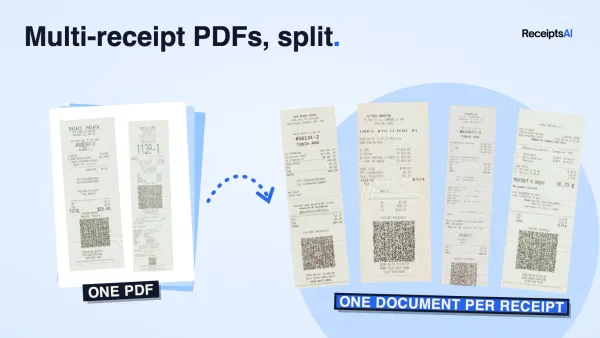
A tool like ReceiptsAI can fit into AP at the point where manual chaos usually starts. Instead of printing invoices or retyping line items, a business can forward invoice emails or upload files, then let the system identify document types, extract key fields, organize files, and prepare records for bookkeeping.
That changes the rhythm of the process:
- Receipt becomes centralized because invoices go to one digital intake point.
- Data capture becomes faster because vendor, date, totals, and document details are extracted from the file.
- Coding becomes easier because records are sorted and categorized before export.
- Reconciliation improves because documents remain searchable and attached to the transaction trail.
If you're evaluating this part of the workflow, this overview of automated invoice processing shows how businesses move from manual document handling to a more organized invoice pipeline.
Why this matters for day-to-day bookkeeping
The biggest gain for a small team isn't only speed. It's consistency. When invoices enter the same system the same way every time, AP becomes easier to supervise. You can focus human attention where it belongs: exceptions, approvals, and unusual payments.
That's the practical shift from chaotic AP to controlled AP. People stop acting as document couriers and start acting as reviewers.
If your AP process still depends on inboxes, spreadsheets, and memory, ReceiptsAI gives you a simple way to centralize invoices, extract key data automatically, organize records, and reduce manual bookkeeping work without turning AP into a complex software project.