
You open the bank account, see less cushion than you expected, and then remember what's due next. Payroll. Rent. A supplier payment you can't push without creating a new problem. The stress usually isn't about whether the business is profitable on paper. It's about whether cash will be there when you need it.
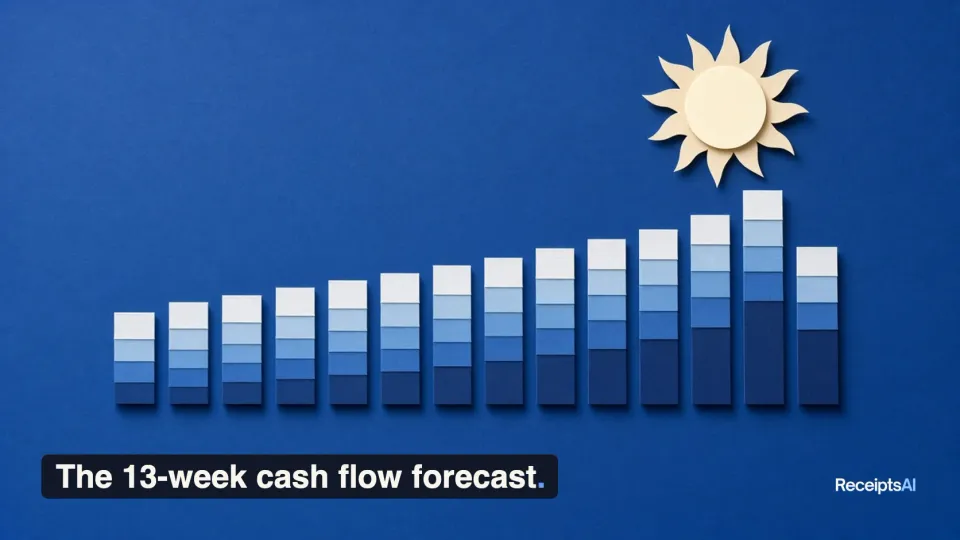
That's where a 13 week cash flow forecast earns its keep. It gives you a practical weekly view of what's likely to hit the bank, what's going out, and where the pressure points sit before they become emergencies. For a small business owner, that's often the difference between controlled decisions and constant scrambling.
Table of Contents
- Why a 13-Week Cash Flow Forecast is Your Business Lifeline
- The Core Components of Your Cash Flow Forecast
- Building Your First 13-Week Cash Flow Forecast
- Common Pitfalls and Proactive Scenario Planning
- Automating Data Collection for a Rolling Forecast
- From Reactive Firefighting to Proactive Financial Control
Why a 13-Week Cash Flow Forecast is Your Business Lifeline
A 13 week cash flow forecast is one of the few finance tools that tells you what matters most in a tight moment. Can you cover the next round of obligations with actual cash, not accounting profit.
That's why it's so widely used when businesses face liquidity pressure. The 13-Week Cash Flow Forecast is the most widely adopted short-term financial model in corporate restructuring and turnaround situations, and it's built to give week-by-week visibility into cash receipts and disbursements using the direct method. In plain terms, it tracks money expected to come in and money expected to leave, with attention on immediate liquidity rather than broad annual assumptions.
Why weekly beats monthly
Monthly reports hide timing problems. If a major customer pays late in the second week of the month and payroll lands in the first, the monthly total may still look acceptable while the bank account gets squeezed at exactly the wrong time.
A 13 week view fixes that. It's short enough to stay grounded in real collections, vendor terms, payroll cycles, tax dates, and debt service. It's also long enough to show whether a rough week is a one-off issue or the start of a pattern.
Practical rule: If your business has ever asked, “Can we afford this next month?” you need a weekly cash view, not just a budget.
Why it matters more than a P&L in a cash crunch
Your profit and loss statement tells you whether the business is making money under accrual accounting. Your 13 week cash flow tells you whether money will be in the account when payroll clears.
That distinction matters for businesses with uneven receivables, seasonal demand, upfront inventory purchases, or recurring tax obligations. A healthy P&L can still sit next to a dangerous cash gap.
If you want a broader overview of the advantages of cash flow forecasting, that resource does a good job explaining why forward-looking cash visibility changes day-to-day decision-making.
What this gives you in practice
A good forecast lets you act earlier. You can chase collections before a shortfall, delay discretionary spending, negotiate vendor timing, or avoid taking on commitments that look manageable but hit at the wrong week.
That's why I treat the 13 week cash flow forecast as a lifeline, not a finance exercise. It doesn't remove uncertainty. It gives you enough visibility to manage it.
The Core Components of Your Cash Flow Forecast
A workable cash forecast isn't built from complicated formulas. It stands on three parts. Starting cash balance, cash inflows, and cash outflows. If those three are clear, the rest becomes manageable.

Starting cash balance
This is the cash you have available at the beginning of the forecast period. Not revenue booked. Not invoices sent. Not inventory on hand. Actual funds in checking, savings, and money market accounts.
For many owners, the first mistake appears. They use a rough estimate or one account balance and miss the actual opening position.
A stronger approach is to tie the opening number back to reconciled bank balances. If you need a quick refresher on balance-sheet building blocks before you do that, this guide on how to calculate current assets helps frame what belongs where, even though your forecast itself should stay focused on cash.
Cash inflows
Inflows are every expected cash receipt during the forecast period. For a small business, that usually includes customer collections first, then anything else that predictably brings money in.
Typical inflow lines include:
- Accounts receivable collections: Payments from invoices already issued.
- Current sales receipts: Card sales, cash sales, online order payouts, or same-week service payments.
- Other income: Rent received, insurance reimbursements, tax refunds, owner contributions, or financing proceeds.
The key is to separate items that behave differently. A retail store might split daily card settlements from wholesale invoice collections. A contractor might separate progress billings from retainage collections. A landlord tracking property-level performance may also find this explanation of understanding rental property profitability useful because it reinforces the difference between earning income and receiving cash.
Cash outflows
Outflows are all expected cash payments, grouped in a way that reflects real timing. Good forecasts don't bury everything under “expenses.” They show what's due, when, and how flexible each payment is.
Common outflow categories include:
- Payroll and contractor payments: Usually the least flexible item.
- Rent and occupancy costs: Lease payments, common area charges, utilities.
- Vendor payments: Inventory, materials, supplies, subcontractors.
- Taxes: Payroll taxes, sales taxes, estimated tax payments.
- Debt service: Loan payments, interest, equipment financing.
- Recurring overhead: Software subscriptions, insurance, phone, marketing retainers.
The forecast becomes useful when line items match the way your business actually spends cash, not the way a generic chart of accounts looks.
If a line is material and timing matters, break it out. That gives you a cleaner view of which obligations are fixed, which can move, and which ones require action now.
Building Your First 13-Week Cash Flow Forecast
The cleanest way to build a 13 week cash flow forecast is to keep it cash-based and weekly from the start. The model is a near-term, rolling forecast that uses the direct method to calculate cash receipts minus disbursements, and the standard process centers on six actions: establish the starting cash position, forecast inflows, forecast outflows, identify liquidity improvements, evaluate capital structure, and refine the strategy with advisors, as outlined by Wall Street Prep's explanation of the 13-week cash flow model.
Start with the real cash position
Pull balances from every bank account that holds available funds. That usually means checking, savings, and money market accounts. If one account is restricted or earmarked for a purpose you can't touch, treat that carefully instead of assuming it's usable operating cash.
Before you lock in the opening number, reconcile it. If your books and bank don't match, the forecast inherits that error immediately. This walkthrough on how to reconcile bank statements is a useful checkpoint if your opening cash number still feels fuzzy.
Forecast receipts the practical way
Inflows should be based on when cash is likely to arrive, not when you hope it arrives. For receivables, start with open invoices and expected payment timing. If a customer usually pays late, forecast them late. If card settlements hit within a predictable pattern, place them in the right week.
Useful inputs include:
- Open A/R aging: Review what's already invoiced and still unpaid.
- Recent payment behavior: Use your actual collection rhythm, not contract language alone.
- Near-term sales expectations: Include only sales that have a reasonable path to cash within the forecast window.
- Non-operating receipts: Add funding draws, refunds, or asset sales only when timing is credible.
If you know your business generally collects on a lag, build that lag into the weeks ahead. False optimism in collections is one of the fastest ways to make a forecast look healthy when it isn't.
Map disbursements by due date
Outflows need more discipline than most owners expect. Start with obligations that are fixed and time-sensitive, then layer in the variable items.
A practical order looks like this:
- Payroll first: Include gross payroll timing and related taxes.
- Then tax payments: Sales tax, payroll tax, and any scheduled estimates.
- Then debt and rent: These usually have hard due dates.
- Then core vendors: Inventory, materials, freight, and critical suppliers.
- Then discretionary spend: Marketing tests, nonessential software, optional purchases.
Trade-offs become apparent. If payroll and taxes consume the week's available cash, you may need to delay a purchase order, speed up collections, or call a supplier before the due date arrives.
A forecast is only useful when it reflects payment reality. “We usually figure it out” is not a forecasting method.
Turn it into a weekly forecast table
At its simplest, each week follows one formula:
Beginning cash + total inflows - total outflows = ending cash
That ending cash becomes the next week's beginning cash. Keep the layout simple enough that you'll maintain it.
Here's a sample structure for the first few weeks.
| Line Item | Week 1 | Week 2 | Week 3 |
|---|---|---|---|
| Beginning Cash | Opening balance | Prior week ending cash | Prior week ending cash |
| A/R Collections | Expected receipts | Expected receipts | Expected receipts |
| Sales Receipts | Expected cash sales | Expected cash sales | Expected cash sales |
| Other Inflows | Refunds, loans, other cash in | Refunds, loans, other cash in | Refunds, loans, other cash in |
| Total Inflows | Sum of inflows | Sum of inflows | Sum of inflows |
| Payroll | Scheduled payroll | Scheduled payroll if due | Scheduled payroll if due |
| Rent | Due if scheduled | Due if scheduled | Due if scheduled |
| Vendor Payments | Planned disbursements | Planned disbursements | Planned disbursements |
| Taxes | Scheduled tax payments | Scheduled tax payments | Scheduled tax payments |
| Debt Service | Loan payments | Loan payments | Loan payments |
| Other Outflows | Insurance, software, misc. | Insurance, software, misc. | Insurance, software, misc. |
| Total Outflows | Sum of outflows | Sum of outflows | Sum of outflows |
| Net Cash Flow | Inflows minus outflows | Inflows minus outflows | Inflows minus outflows |
| Ending Cash | Beginning cash plus net cash flow | Beginning cash plus net cash flow | Beginning cash plus net cash flow |
Build for decisions, not appearances
A forecast isn't supposed to look polished. It's supposed to tell the truth.
If the model shows a cash dip in week four, that's useful. You now have time to collect faster, push an order, talk to a lender, trim spending, or defer an owner draw. If you smooth the numbers to make the sheet look better, you lose the only benefit the exercise provides.
For most small businesses, the best first version is not complex. It's accurate enough to support weekly decisions and simple enough that someone will keep it updated.
Common Pitfalls and Proactive Scenario Planning
Most broken forecasts don't fail because the math is hard. They fail because the inputs drift, assumptions go unchallenged, or nobody revisits the model after the first draft.
Common pitfalls in TWCF modeling include inaccurate data, over-reliance on the tool itself, and model stagnation when the forecast isn't reviewed against actual results. Guidance from Bluebird Partners on 13-week cash flow pitfalls and scenario planning also stresses the importance of best-case, worst-case, and most-likely scenarios.

Where forecasts break down
Bad data is the biggest issue. If bank balances are off, A/R is stale, or expected vendor payments are missing, the sheet gives a false sense of control.
Then there's a more subtle problem. Owners start treating the model as a verdict instead of a tool. Forecasts are directional. They should support judgment, not replace it.
Watch for these warning signs:
- Static assumptions: Collections or costs stay unchanged even when the business has clearly shifted.
- No weekly refresh: Actual receipts and disbursements never replace forecasted numbers.
- Overgrouped expenses: Too many payments are buried in broad labels, hiding timing risk.
- Optimistic receipts: Invoices are forecast by due date instead of customer behavior.
If your forecast always says things will be fine, but cash still gets tight, the problem usually sits in your assumptions, not your spreadsheet format.
How to stress-test the model
Scenario planning is where the forecast becomes strategic. Instead of asking only “What do we think will happen?” ask “What happens if one important thing goes wrong?”
Use three views:
- Best-case: Customers pay on time, sales convert as expected, and no unusual bills land.
- Most-likely: Collections and expenses follow the business's normal pattern.
- Worst-case: A major receivable slips, a tax bill hits early, or a supplier requires faster payment.
For a small business, the scenarios don't need to be elaborate. They just need to reflect real pressure points. A contractor may test delayed collections from one large customer. A retailer may test a week of softer sales plus an inventory payment. A service firm may test slower retainers and a payroll-heavy month.
The value isn't prediction. It's preparation. If the downside scenario creates a cash gap, you can decide now which lever you'd pull first.
Automating Data Collection for a Rolling Forecast
The hardest part of a 13 week cash flow forecast usually isn't the model. It's feeding it every week with clean, current information.
The forecast works best when it uses accurate inputs from sources like bank accounts, accounting software, CRM systems, and credit card statements. For small businesses, that clarity helps prevent shortfalls and manage recurring obligations such as payroll taxes, contractor pay, and rent without needing a complex accounting stack.

Why weekly maintenance is the real challenge
A true rolling forecast doesn't sit untouched. You update it with actual results, revise assumptions, and extend the horizon so the business keeps a current 13-week view ahead.
That sounds simple until the data lives in too many places. Bank statements are in one folder. Receipts are in someone's inbox. Card statements arrive separately. Vendor invoices sit in PDFs. Customer records live in the CRM. Then someone has to collect all of it, key it in, and hope nothing gets missed.
That's where small businesses lose the habit. The model itself might take minutes to update. The document chasing takes far longer.
What to automate first
The best automation targets the tasks that are repetitive, messy, and easy to get wrong by hand.
Start with these:
- Document capture: Pull receipts, invoices, and statements into one system instead of multiple email threads and folders.
- Data extraction: Read dates, totals, taxes, vendors, and payment details automatically.
- Categorization: Route transactions into useful buckets so payroll, rent, loan payments, and vendor spend are easy to track.
- Search and retrieval: Find a bill or statement quickly when a forecast line needs verification.
If you're rekeying figures from PDFs each week, that manual process is the bottleneck. Tools built for automating data entry reduce that burden and make the rolling forecast more realistic to maintain.
One useful way to think about it is this: automation doesn't replace the forecasting judgment. It removes the clerical drag that stops people from keeping the forecast current.
A short demo helps if you want to see what a modern workflow looks like in practice.
Clean inputs matter more than fancy formulas. Most small businesses don't need a more advanced model. They need a forecast they can keep alive every week.
From Reactive Firefighting to Proactive Financial Control
When cash feels unpredictable, owners tend to manage by urgency. They delay one payment, push another, check the account balance repeatedly, and hope next week loosens up. That's exhausting, and it usually leads to weaker decisions.
A 13 week cash flow forecast changes the posture. You stop reacting only to what's due today and start seeing what's coming soon enough to do something useful about it. That may mean accelerating collections, timing a purchase differently, preparing for a tax payment, or deciding not to hire until the cash pattern supports it.
The biggest shift isn't technical. It's managerial. You move from “Can we survive this week?” to “What do we need to change now so the next several weeks stay under control?”
Start simple. Build the first version from real bank balances, realistic collections, and known disbursements. Keep it weekly. Keep it honest. Then keep it moving.
That's how small businesses get out of firefighting mode. Not by guessing better, but by building a habit of forward visibility and maintaining it consistently.
If you want a practical way to cut the manual work behind your forecast, try ReceiptsAI. It helps small businesses organize receipts, invoices, and bank statements, extract key data automatically, and keep bookkeeping records easier to update so your cash flow process is less of a weekly scramble.