
You're usually asked to calculate current assets at the worst possible time. A lender wants updated numbers. Your accountant asks for a balance sheet by Friday. Or you're staring at a P&L that looks fine, but cash still feels tight.
That's when this number stops being accounting trivia.
Current assets tell you what your business can turn into cash, use up, or collect soon enough to handle normal bills. If you get the number wrong, you can look healthier than you are, or weaker than you are. Both are expensive mistakes. I've seen owners count dead inventory like cash and skip prepaid items they already paid for. I've also seen service businesses leave out wallet balances and unpaid invoices, which makes liquidity look worse than it is.
The good news is that this calculation is simple once the accounts are clean and the documents are in one place. The messy part isn't the math. It's gathering the right numbers, classifying them correctly, and checking that each item really belongs in the next twelve months.
Table of Contents
- Your Quick Guide to Calculating Current Assets
- What Counts as a Current Asset
- The Step by Step Method to Calculate Current Assets
- How to Easily Gather Your Financial Documents
- Putting It Into Practice with Worked Examples
- Why This Number Is Critical for Your Business Health
- Frequently Asked Questions About Calculating Current Assets
Your Quick Guide to Calculating Current Assets
If you need the short version, here it is.
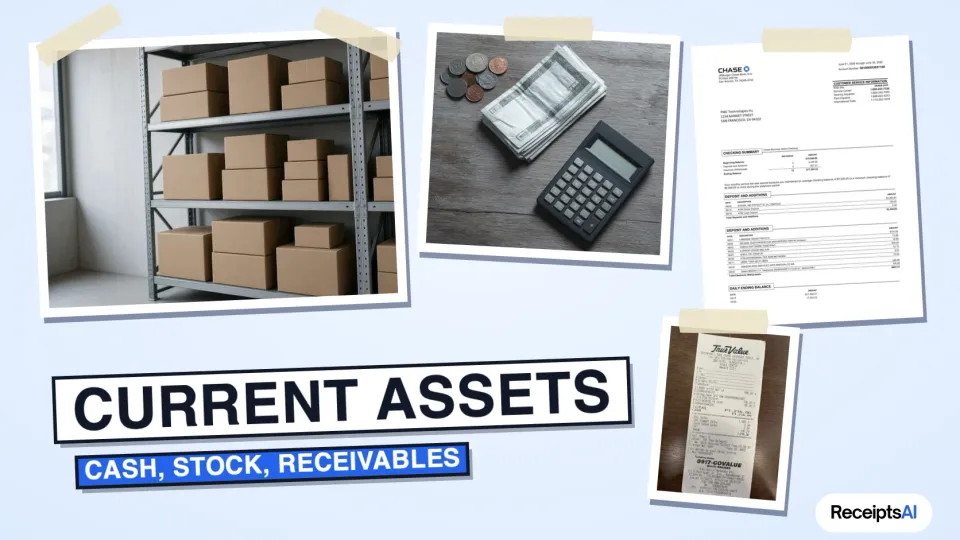
Current assets are the resources your business expects to convert to cash, sell, or use up within a year. Think of them as the part of your balance sheet that can help pay near-term obligations without selling equipment or taking on new debt.
In practice, most small businesses calculate current assets by adding up:
- Cash
- Cash equivalents
- Inventory
- Accounts receivable
- Marketable securities
- Prepaid expenses
- Other liquid assets
That sounds straightforward, and the formula is. What trips people up is the practical detail. Is old inventory still worth what your books say it's worth? Are customer invoices still collectible? Does that annual insurance payment belong entirely in the current year? Should your PayPal balance be included?
Practical rule: If you can reasonably turn it into cash, collect it, sell it, or use the benefit within the next operating cycle, it probably belongs in current assets. If not, it probably doesn't.
This number matters because it's one of the clearest snapshots of short-term financial health. It helps you answer practical questions fast. Can payroll clear without stress? Can you buy stock before a busy period? Will a lender see a stable business or a strained one?
The math is the easy part. The useful part is learning how to calculate current assets from real books, not perfect textbooks.
What Counts as a Current Asset
Current assets are resources expected to be converted into cash, sold, or used up within a strict twelve-month operating cycle. That's the universal standard under GFRS and IFRS, and these assets typically make up 40% to 60% of total assets for healthy small enterprises according to Ambrook's explanation of current assets.
The rule that matters most
Use the twelve-month rule first.
If an asset won't become cash, get sold, or be consumed within that window, don't treat it as current. That's why a van, a building, or a long-term certificate of deposit doesn't belong here. They may be valuable, but they won't help you cover next quarter's rent or supplier bills.
A simple way to think about it is this: current assets are your business's near-term fuel. Fixed assets are the machinery and structure. Both matter, but they do different jobs.
If you're still fuzzy on where assets fit compared with obligations, this quick guide to assets vs liabilities helps clarify the split.
Current assets cheat sheet
| Asset Type | Include in Current Assets? | Reason |
|---|---|---|
| Cash | Yes | Money available immediately in checking, savings used for operations, or petty cash. |
| Cash Equivalents | Yes | Short-term highly liquid holdings that are close to cash in practice. |
| Accounts Receivable | Yes | Money customers owe you for work already done or goods already delivered. |
| Inventory | Yes | Goods you expect to sell within the operating cycle, if valued properly. |
| Marketable Securities | Yes | Short-term liquid investments you can convert without much delay. |
| Prepaid Expenses | Yes | Amounts already paid for services or coverage that will be used within the year. |
| Other Liquid Assets | Yes | Short-term items that can be turned into value quickly, if clearly documented. |
| Property and Equipment | No | Buildings, vehicles, machinery, and equipment are long-term assets. |
| Long-term Investments | No | Investments held beyond the current operating cycle don't support near-term liquidity. |
| Intangible Assets | No | Trademarks, goodwill, and similar items aren't near-term liquid resources. |
| Long-term Deposits | No | Deposits or prepayments extending past the current year don't belong here. |
A few categories deserve extra caution.
Inventory belongs only if it can realistically be sold within the operating cycle and is valued conservatively. Prepaid expenses belong only for the portion that gives benefit within the year. Receivables belong only if they're still collectible. Those three accounts create most of the cleanup work in small business bookkeeping.
Old inventory isn't a liquid asset just because it's sitting on a shelf. If nobody will buy it, your balance sheet shouldn't pretend otherwise.
The Step by Step Method to Calculate Current Assets
Start with the full formula
The standard formula is:
Current Assets = C + CE + I + AR + MS + PE + OLA
That stands for cash, cash equivalents, inventory, accounts receivable, marketable securities, prepaid expenses, and other liquid assets.

To calculate current assets cleanly, pull your latest balance sheet and verify each line item instead of trusting last month's ending balances blindly. That last part matters. A number can sit in the right account and still be wrong.
How to verify each component
Cash and cash equivalents come first. Include business checking, operating savings used for short-term needs, petty cash, and qualifying near-cash instruments. Exclude funds locked away for the long term.
Inventory is where many books drift off course. Use the lower of cost or net realizable value. In plain English, that means inventory should be carried at what it cost or what you can realistically recover from selling it, whichever is lower. Verified guidance states that using this granular method helps experts reach 96% accuracy, and that obsolete stock often inflates assets by 8% to 12% in common audit failures.
Accounts receivable is money customers owe you for completed work or delivered goods. Review aging. If a receivable is stale or doubtful, don't treat the full balance like spendable liquidity. In such cases, an allowance for uncollectible accounts becomes useful, as it keeps your receivables realistic.
Marketable securities count when they're genuinely short-term and liquid. If you'd have to wait, take a penalty, or hold them for strategic reasons, they may not belong in current assets.
Prepaid expenses often get overstated. Include only the portion that gives economic benefit within the fiscal year. Verified guidance specifically warns that prepaid expenses should be counted only when their benefit is realized within that period.
Other liquid assets is the catch-all, but don't use it as a junk drawer. If you can't explain what the asset is, how it becomes cash or value soon, and where the supporting document lives, it probably shouldn't stay there.
A reliable workflow looks like this:
- Pull the latest balance sheet and list every account currently marked as current.
- Match each account to support such as bank statements, inventory records, invoice aging, or prepaid schedules.
- Adjust for reality by removing obsolete stock, doubtful receivables, and long-term prepayments.
- Add the verified balances to reach your final current asset total.
How to Easily Gather Your Financial Documents
Why document collection slows everything down
Most owners don't struggle with the addition. They struggle with the scavenger hunt.
Cash sits across bank portals and wallet accounts. Receivables live in your invoicing system, email, or someone's spreadsheet. Prepaids hide in old insurance renewals, software receipts, and lease paperwork. Inventory support is often split between POS systems, supplier invoices, and manual counts. By the time you've gathered everything, you're already tired, and that's when classification errors creep in.
A messy file system creates another problem. When support is scattered, you can't verify balances quickly. That slows down month-end close, makes lender requests painful, and leaves gaps when someone asks why a number changed.
For teams thinking beyond bookkeeping convenience, this guide on boosting audit readiness with DMS is worth reading because document control is what makes financial review repeatable.
A cleaner workflow for monthly reviews
A better process is boring in the best way. Financial documents should flow into one system, get classified consistently, and stay searchable by vendor, date, amount, and account type.

That's where automation helps. Instead of downloading statements one by one and renaming files manually, you can forward invoices, upload PDFs and spreadsheets in bulk, and centralize support in one place. The practical win isn't just speed. It's consistency. When documents are auto-sorted and searchable, it becomes much easier to verify current asset balances without missing a prepaid renewal or an unpaid invoice.
The same logic applies to cash. If your bank statements are reconciled regularly, your cash line becomes reliable instead of hopeful. If that process is still loose, this walkthrough on how to reconcile bank statements is a useful place to tighten it up.
Good bookkeeping doesn't mean memorizing formulas. It means being able to point to the document behind the number in a few clicks.
When you calculate current assets every month, centralized records cut friction. They also make it easier to spot stale inventory, duplicate entries, and receivables that shouldn't still be sitting at full value.
Putting It Into Practice with Worked Examples
Example one retail business
A retail shop owner wants to calculate current assets before talking to a lender. The books show:
- Cash: $50,000
- Inventory: $30,000
- Accounts receivable: $20,000
The math is simple:
Current Assets = $50,000 + $30,000 + $20,000 = $100,000
That exact example is consistent with the verified current asset formula example provided in the source material. What matters in real life is checking the inputs before you total them. Is the inventory still saleable at that value? Are those receivables still collectible? If yes, the $100,000 figure is useful. If not, the total needs adjusting before anyone relies on it.
Retail owners should be strict with inventory review. A shelf full of old stock can make the balance sheet look stronger than the bank account feels.
Example two service business
A consulting firm has a cleaner balance sheet. It doesn't carry inventory, but it still has current assets. The owner reviews the books and finds:
- Cash: operating funds in the business bank account
- Accounts receivable: unpaid project invoices
- Prepaid expenses: annual software and insurance paid in advance, limited to the portion benefiting the current year
In this case, the calculation is still the same formula, just with fewer categories populated. The owner adds verified cash, collectible receivables, and valid short-term prepaids to reach the current asset total.
Service businesses often make two opposite mistakes. Some leave out receivables and understate liquidity. Others count every unpaid invoice at full value, even when some clients are dragging. Both produce a distorted result.
A practical review for a service business looks like this:
- Check bank balances against reconciled statements
- Review invoice aging and question stale balances
- Split annual prepayments so only the current portion is included
- Exclude long-term deposits and owner-only personal balances
The right current asset number should feel defensible. If a lender, bookkeeper, or auditor asked for support, you should be able to show it line by line.
The worked examples show the pattern. The categories may change by business model, but the discipline doesn't. Gather the support, verify the timing, adjust weak balances, then total the amount.
Why This Number Is Critical for Your Business Health
Your current asset total becomes more useful when you compare it to current liabilities. That gives you the current ratio, which is one of the fastest ways to judge short-term financial stability.

What the current ratio tells you
The formula is:
Current Ratio = Current Assets / Current Liabilities
According to Allianz Trade's overview of the current ratio, a business is generally considered financially stable when current assets exceed current liabilities by a factor of 1.5 to 2.0. The same source gives a clear example: $200,000 in current assets divided by $100,000 in current liabilities produces a 2.0 current ratio, historically associated with strong liquidity and low default risk.
If your ratio drops below 1.0, that's a warning sign. It means you may not have enough near-term assets to cover near-term obligations without borrowing, delaying payments, or selling something under pressure.
This video gives a useful visual explanation of how these liquidity measures work in practice.
When the quick ratio gives the better answer
The current ratio is broad. The quick ratio is stricter because it excludes inventory.
That matters when inventory is slow-moving, seasonal, or hard to liquidate fast. A business can look fine on the current ratio and still feel strained if too much of its liquidity is tied up on shelves or in stockrooms. In that situation, the quick ratio gives a sharper answer to a practical question: if sales slowed tomorrow, could the business still meet short-term obligations from its most liquid resources?
This is why owners should look at liquidity as an operating tool, not just a reporting requirement. If you're trying to improve short-term financial control, this resource on MyOfficeOps cash flow management adds helpful guidance on the broader working-capital side.
Use the number to make decisions. Tighten collections. Trim dead stock. Delay nonessential purchases. Renegotiate supplier timing. Current assets are not just a box on the balance sheet. They're part of how you stay out of cash trouble.
Frequently Asked Questions About Calculating Current Assets
How do I handle work in progress or inventory that takes longer than a year
Use judgment tied to the operating cycle, not just the calendar. Verified data shows 34% of small businesses misreport inventory because of unclear timing thresholds such as work-in-progress and seasonal stock. If the item belongs to your normal production cycle, document the basis for including it and value it conservatively. If value is uncertain, don't guess high.
Should I include cryptocurrency or digital wallet balances
Potentially, yes, but only if they function like liquid business-held assets and you can document control, access, and valuation clearly. Verified data also notes that 41% of service-based businesses incorrectly exclude highly liquid digital assets from current asset calculations, which can make liquidity look weaker than it is. The key issue is support and classification, not trendiness.
How often should I calculate current assets
Monthly is best for most small businesses. Quarterly is the minimum if your operation is stable and simple. If inventory swings, receivables age unevenly, or cash gets tight seasonally, monthly review gives you a better chance to catch problems before they turn into emergencies.
If you want the process to stop feeling like a document hunt, ReceiptsAI makes it much easier to organize receipts, invoices, statements, and supporting files in one searchable place. That gives you a cleaner path to accurate bookkeeping, faster balance sheet reviews, and current asset numbers you can trust.