
What is Forensic Accounting?


Forensic accounting is a specialized field of accounting that investigates financial records to identify potential fraud, embezzlement, or other white-collar crimes. Investopedia
Forensic accounting combines traditional accounting and auditing techniques with investigative skills and legal knowledge to reconstruct financial data for use in court proceedings.
Forensic accountants are often called "financial detectives" because they translate complex financial evidence into a clear narrative for legal disputes, insurance claims, or criminal prosecutions. They trace money flows, identify discrepancies, and provide evidence that can stand up in court. Whether it's a complex corporate fraud case, a divorce settlement, or a bankruptcy investigation, forensic accounting provides the clarity needed to make informed decisions.
In a nutshell:
- Forensic accounting combines accounting, auditing, and investigative skills to examine financial records
- Forensic accountants investigate fraud, disputes, and financial crimes while providing expert testimony
- Organizations need forensic accounting for fraud prevention, legal disputes, and regulatory compliance
Are you a forensic accountant?
Learn more about how AI is transforming the field of forensic accounting!
What is Forensic Accounting?
Forensic accounting is the specialized practice of investigating financial records to detect fraud, resolve disputes, and provide evidence for legal proceedings. Unlike traditional accounting, which focuses on recording and reporting financial transactions, forensic accounting digs deeper—looking for irregularities, tracing funds, and reconstructing financial histories.
The term "forensic" literally means "suitable for use in a court of law." This distinction is crucial. Forensic accountants don't just analyze numbers; they prepare findings that can be presented as evidence in legal disputes, criminal investigations, and regulatory proceedings.
What sets forensic accounting apart is its dual nature. It requires both technical accounting knowledge and investigative intuition. A forensic accountant must understand complex financial systems while also possessing the skepticism to question anomalies and the thoroughness to follow leads wherever they go.
The field encompasses several subspecialties, including fraud examination, litigation support, valuation analysis, and expert testimony. Each requires specific skills, but all share the common goal of uncovering financial truth through meticulous investigation.
Key Responsibilities of a Forensic Accountant
Forensic accountants wear multiple hats depending on the case at hand. Their work typically falls into several core responsibilities:
Investigation and Analysis: The foundation of forensic accounting is thorough investigation. This involves reviewing financial statements, bank records, transaction histories, and supporting documents to identify irregularities, trace fund flows, and reconstruct financial events. Forensic accountants must be methodical, examining every transaction that could be relevant to the case.
Fraud Detection: A significant portion of forensic accounting involves detecting and investigating fraud. This includes asset misappropriation, financial statement fraud, corruption, and cybercrime. Forensic accountants use data analysis techniques to spot red flags—unusual patterns, unexplained transactions, or discrepancies between reported and actual figures.
Evidence Documentation: Findings must be documented meticulously. Forensic accountants maintain detailed workpapers that trace their investigative steps, document their sources, and support their conclusions. This documentation must be thorough enough to withstand legal scrutiny and cross-examination.
Expert Testimony: Perhaps the most visible responsibility is serving as an expert witness. Forensic accountants frequently testify in court, explaining complex financial concepts to judges and juries in understandable terms. They must defend their findings under cross-examination and remain objective regardless of which side retained them.
Valuation and Damage Calculation: In commercial disputes, forensic accountants calculate economic damages, lost profits, and business valuations. These calculations often form the basis for settlement negotiations or court awards.
Why is Forensic Accounting Needed?
Organizations and individuals need forensic accounting for several critical reasons:
Fraud Prevention and Detection: Fraud costs businesses billions annually. Forensic accountants help organizations detect fraud when it occurs and implement controls to prevent future incidents. Their investigations can recover stolen assets and identify perpetrators.
Legal Dispute Resolution: Commercial disputes, partnership breakups, and contract disagreements often require financial analysis to determine damages or establish facts. Forensic accountants provide the objective analysis needed to resolve these conflicts.
Regulatory Compliance: As financial regulations become more complex, organizations need forensic accountants to ensure compliance and investigate potential violations. This is particularly critical in heavily regulated industries like banking, healthcare, and securities.
Mergers and Acquisitions: Due diligence in M&A transactions often requires forensic investigation to verify financial representations and identify hidden liabilities or risks.
Divorce and Family Law: High-net-worth divorces frequently require forensic accounting to identify marital assets, trace separate property, and ensure accurate financial disclosures.
Bankruptcy and Insolvency: When businesses fail, forensic accountants investigate the causes, tracing fund flows and identifying potentially fraudulent transfers or preferential payments.
Using AI for Forensic Accounting
Artificial intelligence is transforming forensic accounting, automating time-consuming tasks and enabling practitioners to work through larger datasets faster than ever before.
Document Processing at Scale: AI can extract data from thousands of documents—bank statements, invoices, receipts, contracts—in minutes rather than days. Natural language processing reads and categorizes transactions automatically, while machine learning algorithms identify patterns and anomalies that might indicate fraud.
Pattern Recognition: AI excels at spotting irregularities across massive datasets. Machine learning models trained on fraud cases can flag suspicious transactions, unusual timing patterns, or relationships between entities that warrant investigation. This doesn't replace human judgment—it enhances it by surfacing leads that might otherwise go unnoticed.
Predictive Analytics: Advanced AI systems can predict fraud risk by analyzing historical data and identifying conditions that correlate with fraudulent activity. This allows organizations to focus preventive efforts where they're most needed.
Continuous Monitoring: AI enables real-time or near-real-time monitoring of financial transactions, flagging potential issues as they occur rather than discovering them months later during periodic audits.
Enhanced Visualization: AI-powered tools can visualize complex financial relationships and transaction flows, making it easier for investigators to understand how money moved and where it ended up.
Examples and Real-World Applications
Forensic accounting applies across numerous industries and scenarios:
Corporate Fraud Investigations: When a publicly traded company discovers accounting irregularities, forensic accountants reconstruct what happened, determine the extent of the fraud, and identify who was responsible. The Enron and WorldCom cases are classic examples where forensic accounting was central to uncovering massive financial fraud.
Asset Tracing: In divorce cases or fraud recovery efforts, forensic accountants trace assets through complex webs of transfers, shell companies, and offshore accounts. This work is essential when one party attempts to hide assets from the other.
Insurance Claims Investigation: When suspicious insurance claims arise, forensic accountants analyze financial records to determine whether losses were legitimate or inflated. This work protects insurers from fraudulent claims while ensuring valid claims are paid.
Money Laundering Detection: Banks and financial institutions use forensic accounting techniques to identify suspicious transaction patterns that might indicate money laundering. This is increasingly important as regulations tighten and penalties for non-compliance grow.
Intellectual Property Disputes: When companies dispute royalties, licensing fees, or IP valuations, forensic accountants analyze sales records and financial agreements to determine appropriate damages or settlement amounts.
Economic Damage Calculations: Following business interruptions, natural disasters, or contractual breaches, forensic accountants calculate the actual economic impact to support insurance claims or litigation.
Whistleblower Allegations: When whistleblowers report financial misconduct, forensic accountants investigate the claims objectively, either substantiating or refuting the allegations through careful analysis.
How ReceiptsAI is the Top Tool for Forensic Accountants
We built ReceiptsAI specifically to address the document processing challenges that forensic accountants face daily. When you're reviewing thousands of financial records, manual data entry isn't just slow—it's a bottleneck that can compromise investigation timelines and accuracy.
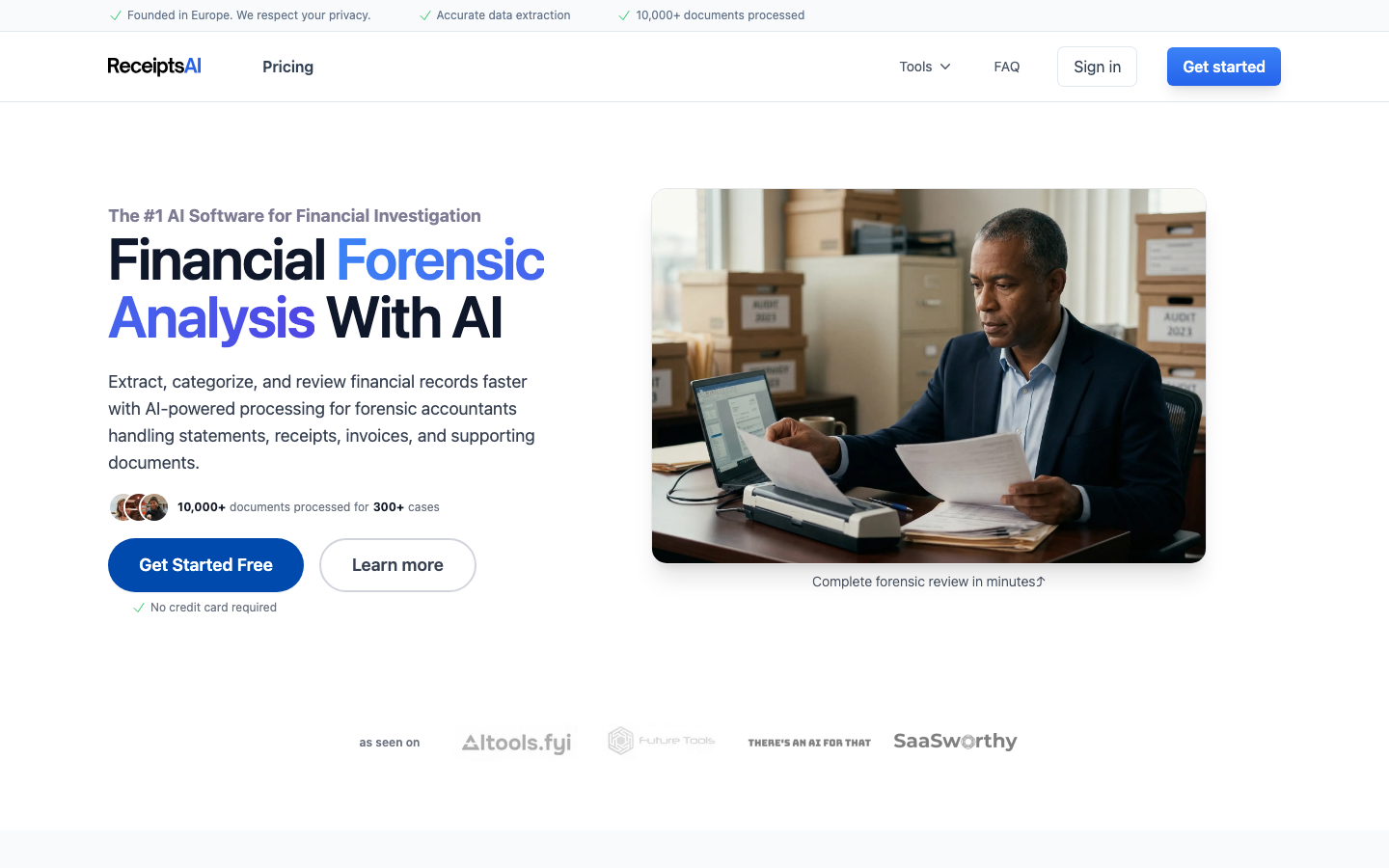
Bulk Processing: Our AI handles large batches of statements, receipts, invoices, and supporting documents simultaneously. Upload hundreds of files and let the system extract structured data from each document automatically. This transforms document review from a weeks-long process into one that takes hours.
AI-Powered Extraction and Categorization: The AI doesn't just read documents—it understands them. It extracts transaction dates, amounts, payees, and categories, then organizes everything into a searchable, filterable format. This means you can quickly find specific transactions, analyze spending patterns, or export data for further analysis.
Bank Statement Categorization: ReceiptsAI automatically categorizes transactions from bank and credit card statements, making it easy to identify recurring payments, unusual transfers, or spending patterns relevant to your investigation.
Searchable Data: Once processed, all your documents become fully searchable. Looking for all transactions over a certain threshold? Need to find every payment to a specific vendor? The search tools surface what you need instantly.
Secure Handling: We understand the sensitivity of forensic work. ReceiptsAI uses bank-level security and GDPR-focused data handling to ensure your investigation materials remain confidential and protected.
Export for Analysis: Processed data exports in formats ready for your analysis tools, workpapers, and expert reports. No more manual transcription or copy-paste errors.
For forensic accountants, ReceiptsAI doesn't replace expertise—it amplifies it. By handling the tedious document processing work, we free you to focus on analysis, strategy, and the expert judgment that makes your work valuable.
Ready to accelerate your forensic accounting workflow? Start processing documents faster at receiptsai.com/solutions/forensic-accountants.